Advertisement
Govt puts 22 counties under high Ebola risk alert as 3 test negative
Friday 22nd May, 2026 09:13 PM|

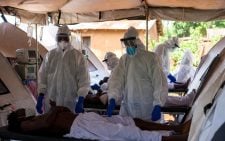
The government has placed 22 counties under high-risk Ebola surveillance even as Health Cabinet Secretary Aden Duale confirmed that no Ebola case has been detected in the country.
In a statement on Friday, May 22, 2026, Duale said that the ministry remains on heightened alert following the ongoing Ebola Virus Disease (EVD) outbreak in the Democratic Republic of Congo (DRC) and Uganda.
He noted that the regional outbreak has already been declared a Public Health Emergency of International Concern by the World Health Organisation (WHO) and a Public Health Emergency of Continental Security by the Africa Centres for Disease Control and Prevention.
Duale reassured that there is currently no confirmed Ebola infection in the country despite recent fears sparked by viral social media reports claiming a case had been detected in Uasin Gishu County.
You Might Also Like


“I wish to reassure all Kenyans that, as of 21st May 2026, Kenya has not reported any confirmed case of Ebola Virus Disease,” the statement read in part.
The ministry disclosed that three individuals who had recently travelled from the DRC were isolated and tested after presenting themselves at health facilities with unrelated illnesses.
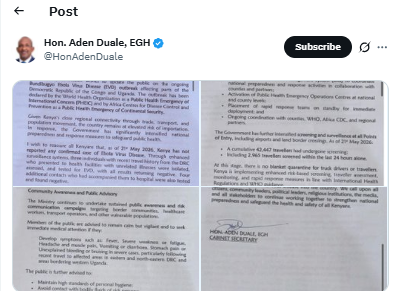
“Through enhanced surveillance systems, three individuals with recent travel history from the DRC who presented to health facilities with unrelated illnesses were isolated, assessed, and tested for EVD, with all results returning negative,” Duale said.
The government further confirmed that four additional individuals who had accompanied the travellers to the hospital were also tested and found negative.
“Four additional contacts who had accompanied them to the hospital were also tested and found negative,” the statement added.
Even so, the government warned that Kenya remains vulnerable because of its close regional connectivity through trade, transport and population movement across East Africa.

Is Kenya safe?
As part of intensified preparedness efforts, the Ministry of Health, through the Kenya National Public Health Institute, has identified 22 counties considered to be at high risk of Ebola importation.
Some of the counties listed include Nairobi, Mombasa, Busia, Bungoma, Trans Nzoia, Kericho and Turkana, among others, located along key transport corridors and border entry points.
The ministry revealed that 118 rapid response personnel have already been placed on standby, while more than 880 national and county healthcare workers have undergone sensitisation on Ebola preparedness and response measures.
According to the statement, the government has also activated a multi-sectoral Incident Management System to coordinate preparedness activities in collaboration with counties and international partners.
Other measures include the activation of Public Health Emergency Operations Centres at national and county levels and the deployment of rapid response teams for emergency action.
The ministry further disclosed that enhanced screening and surveillance measures have been rolled out at all points of entry, including airports and land border crossings.
“As of 21st May 2026, a cumulative 42,447 travellers had undergone screening, including 2,965 travellers screened within the last 24 hours alone,” the statement read.

Authorities clarified that Kenya has not imposed any blanket quarantine measures on truck drivers or travellers, saying the country is instead implementing enhanced risk-based screening, traveller assessment, monitoring and rapid response systems in line with International Health Regulations and WHO guidance.
To strengthen laboratory preparedness, Kenya has designated four national Ebola testing centres, including the National Public Health Laboratory, KEMRI Nairobi, KEMRI Kisumu and a mobile laboratory platform for rapid deployment where necessary.
MOH also urged members of the public to remain vigilant and seek immediate medical attention if they develop symptoms associated with Ebola, including fever, severe weakness, vomiting, diarrhoea, headache, muscle pain or unexplained bleeding, especially after recent travel to affected regions.
At the same time, Duale warned Kenyans against spreading unverified reports that could trigger panic.
“The public is advised to rely only on official information issued by the Ministry of Health, KNPHI, WHO and Africa CDC,” he said.
The ministry added that it will continue monitoring the regional situation closely and keep the public informed.
Author
Latest News








Advertisement
More on News