Advertisement
Governors and State to iron out devolved functions row
Thursday 18th January, 2024 05:00 AM|
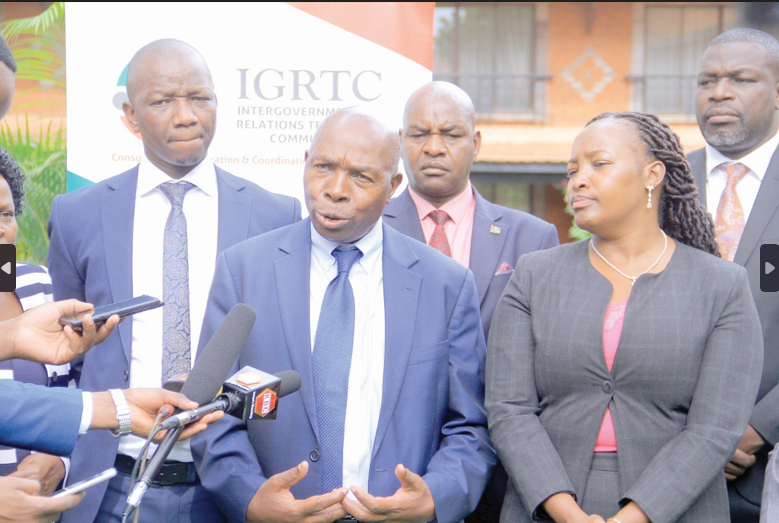
Governors and top government officials are set to converge in Naivasha from Tuesday next week to unlock a stalemate between counties and national government over transfer of functions worth Sh272.2 billion.
This will be second meeting to take place after technical officers drawn from counties, national government and Intergovernmental Relations Technical Committee met last year to identify modalities over how these functions will be devolved and the capitation required.
Speaking after meeting with Principal Secretaries, Devolution Principal Secretary Teresia Mbaika said the meeting will also identify key areas that should be amended to avoid court injunctions once they are transferred.
“We are set and everything is on course. During the summit last year, President William Ruto extended this process for two months.
“A lot has taken place and by the end of the year, we expect every function that is supposed to devolved has been devolved,” said Mbaika. “Devolution works well through consultations.”
Serious conclusions
IGRTC chairman Kithinji Kiragu said next week’s meeting in Naivasha will also provide an opportunity for stakeholders to align the transfer with the government’s economic blue print.
“The Implementation Bottom Up Economic Transformation Agenda (Beta) requires proper devolution. We will consult and make serious conclusions,” he said.
The IGRTC identified sections of at least 10 decentralised functions that are still performed from the centre and the accompanying budget remains with the national Executive.
The committee has also picked several laws and recommended their amendment to fully entrench devolution.
Last month, President Ruto gave the IGRTC two months to engage stakeholders to avert a looming clash and court battles over the functions.
“Accordingly, I have instructed IGRTC to thoroughly engage all relevant stakeholders to avoid conflicts and acrimonious litigation in court,” Ruto said.
In its report on the bundling and valuation of the functions tabled before the Senate’s Devolution and Intergovernmental Relations Committee by Kiragu late last year, IGRTC identified several functions.
The report reveals that the Ministry of Health and agencies under it are performing 45 elements of the health function that exclusively belong to the counties.
“Four other elements of the function identified and unbundled as concurrent to be transferred to the counties,” the report states.
The health functions are worth Sh3.2 billion. “The counties have been assigned exclusive functions, which do not require co-sharing of responsibilities with the national government,” Kiragu said.
The Ministry of Water, the report shows, is performing 18 elements of functions with a total budget of Sh58 billion.
In education, IGRTC has identified 52 elements and unbundled as exclusive to the county governments, recommending their transfer to the devolved units.
“The national government is restricted to education policy, standards, curricula and examinations. Implementation is a mandate of the county governments,” the report says.
Devolved functions
The Energy ministry and its agencies are still holding onto devolved functions worth Sh59 billion.
Four new elements of the function identified and unbundled as exclusive to the county government and two elements identified and unbundled as concurrent to be transferred to county governments,” the report states.
Further, the report shows that some 41 elements of agriculture function are still being performed by the state. The functions are worth Sh105 billion.
The IGRTC report indicates that the national government is restricted to the agriculture policy formulation function.
“Any subsequent responsibility assigned to the national government should be determined through an intergovernmental mechanism and not part of functional assignment to the national government,” it adds.
Author
Alvin.Mwangi
View all posts by Alvin.MwangiLatest News




Advertisement
More on News
