Advertisement
Four counties to pilot anti-malaria strategy
Tuesday 27th April, 2021 12:00 AM|
George Kebaso @Morarak
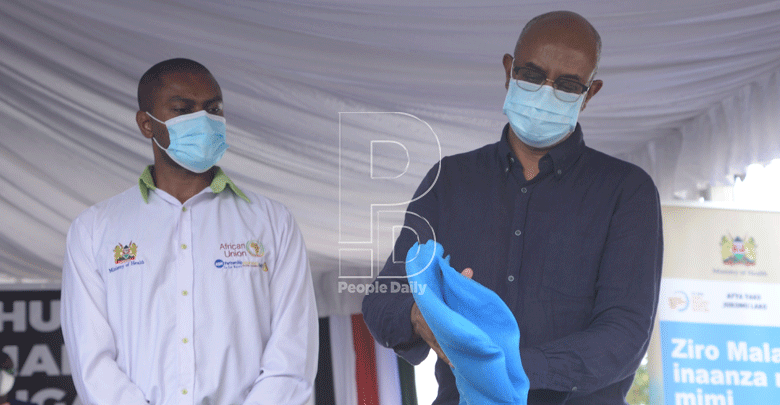
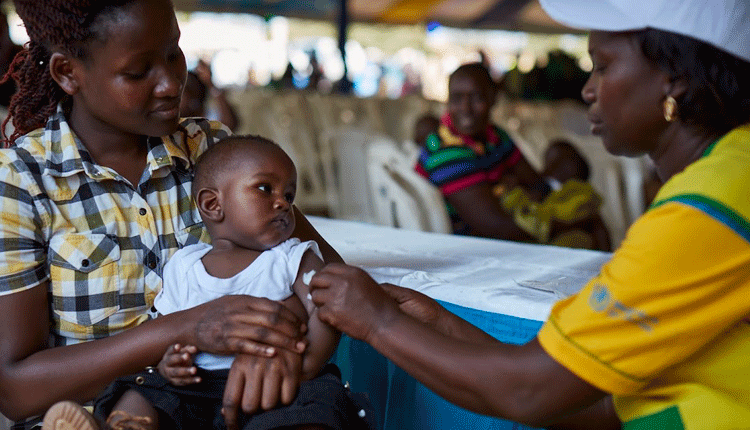
Nyeri, Kirinyaga, Laikipia and Nyandarua counties have been selected to pilot the maiden strategy to eliminate malaria by 2030.
It is the first time ever for the country to have an elimination strategy for the disease that kills approximately 10,700 people annually and about 3.5 million new clinical cases annually. This may, however, sound ironical as to the choice of counties that usually have low malaria transmission to pilot this strategy.
To answer this concern though, experts say, is basically a science-based criterion.
You Might Also Like
According to Dr Willis Akhwale, a malaria expert and Senior Advisor, African Leaders Malaria Alliance, choice of the four counties is a practice across the globe where areas targeted for elimination must present low transmission in order to clear the parasite and vectors that causes malaria.
“You choose an area of focus where malaria incidence is lowest in order to put in place proper disease surveillance using the available science to eliminate,” he told People Daily yesterday.
Further, Akhwale explained that the choice of the four counties informs the country’s surveillance efforts to eliminate malaria as bid to control the disease in endemic areas such as in Nyanza, Western Kenya and the Coastal region are on going.
Few parasites
“Where we have few parasites, it is easier to eliminate them with very little money, whereas in malaria endemic areas, the control programmes are based more on resource intensity,” he said.
The programme is expected to be achieved within a year.
On his part, Dr Bernhards Ogutu, a lead RTS,S malaria vaccine researcher, concurs with Dr Akhwale, saying the journey towards disease eradication – a long and tedious journey that involves various clinical trials and tests – starts with low disease transmission areas.
“You start with low malaria transmission areas as you move gradually as you continue to shrink the incidences and progress to reduction in endemic areas where control programmes are ongoing,” he said.
We are basically doing what the rest of the world is doing. You can only do elimination in low transmission areas and this purely based on science, he noted.
Dr Erjesa Waqo, a Public Health expert, and former head of the Division of Malaria Control at the Ministry of Health, said the disease management is done in phases.
“Elimination, control and eventual eradication are programmes done in phases. In the case of Kenya; control mode is in Western Kenya, Nyanza and Coastal regions that are high transmission areas, but in elimination you choose where it is the lowest and eliminate. You do well when you have reached a level where you are eradicating,” he said.
Dr Waqo noted that elimination is done in low transmission areas until malaria incidence becomes notifiable, meaning one is able to tell where transmission is coming from.
“We have been in control mode for a long time. It is high time to shift the gears to higher mode, that is why we have an elimination strategy, to heighten surveillance, meaning deploying microscopic investigations in areas where malaria parasites are hard to find. This will help us gauge the level of disease incidence in the country,” he added.
Cuban experts
A team of Cuban experts jetted into the country last week to spearhead a biological control of mosquito vectors.
Health Cabinet Secretary Mutahi Kagwe on Sunday said the team follows an agreement between Kenya and Cuba in 2019 for both countries to undertake a two-year project on use of biological methods for the control of mosquito vectors.
In 2019, Kenya signed an agreement with the Cuban Government who successfully managed to eliminate malaria in 1973 to spearhead Malaria Vector Control Project.
It targets eight counties in the malaria lake endemic zone comprising Kisumu, Siaya, Migori, Homa Bay, Busia, Bungoma, Kakamega and Vihiga.
“I am happy to report that the much awaited technical cooperation between Kenya and Cuba has finally come to fruition. Indeed, experts from Cuba arrived in the country this week.
“They will be working with their Kenyan counterparts at both national and county level to map out key breeding sites for spraying using biological methods to kill the mosquito larvae at the breeding sites,” he said.
Author
George Kebaso
View all posts by George KebasoLatest News





Advertisement
More on News