EPRA reduces fuel prices in June 14 review
By Faith Lagat, June 14, 2026The Energy and Petroleum Regulatory Authority (EPRA) has announced a slight reduction in pump prices for petrol and diesel for the June-July 2026 cycle.
In a notice issued on Sunday, June 14, 2026, the regulator announced that prices for super petrol and diesel will decrease by Ksh0.22 per litre and Ksh10.00 per litre, respectively.
In the period under review, the price of kerosene remains unchanged.
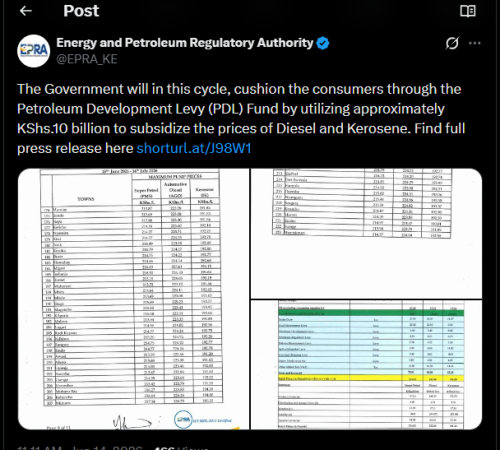
“In the period under review, the maximum allowed petroleum pump prices for Super Petrol and Diesel decreases by Ksh0.22/litre and Ksh10.00/litre respectively while the price of Kerosene remains unchanged,” EPRA stated in its X post.
Following the review, in Nairobi, Super Petrol, Diesel and Kerosene will now retail at Ksh214.03, Ksh222.86 and Ksh191.38 effective midnight on June 14, 2026, for the next 30 days.
Kenyan motorists will therefore wake up to revised fuel prices from Monday, June 15, 2026, after EPRA released its latest monthly fuel pricing review covering the period up to July 14, 2026.
The review delivers the biggest relief to diesel consumers, with the maximum retail price of the fuel dropping by Ksh10 per litre. Super petrol prices have been reduced marginally by Ksh0.22 per litre, while kerosene prices remain unchanged.
Landed costs and subsidy support
According to EPRA, the average landed cost of imported super petrol declined by 0.56 per cent, contributing to the slight reduction in pump prices. Diesel registered a marginal increase of 0.21 per cent in landed cost, while kerosene recorded a 0.33 per cent decline.
Despite the increase in diesel’s landed cost, government intervention through the Petroleum Development Levy (PDL) Fund helped cushion consumers from higher prices.
EPRA emphasised that the pricing structure is guided by the Petroleum Pricing Regulations, which allow for the recovery of importation and distribution costs while protecting consumers from sharp fluctuations in international oil markets.
The regulator also noted that the exchange rate between the US dollar and the Kenyan shilling remained relatively stable during the review period, ranging between 129.5 and 130.08, helping minimise currency-related pressure on fuel prices.
Regional prices and tax component
In Mombasa, super petrol will retail at Ksh210.87 per litre, diesel at Ksh219.58 and kerosene at Ksh188.09. Prices in other towns vary depending on transport costs, storage charges and distribution margins as outlined in EPRA’s Annex I covering more than 200 locations nationwide.
The landed cost breakdown for Nairobi places super petrol at Ksh117.64 per litre, diesel at Ksh168.47 and kerosene at Ksh172.79.
Final pump prices are determined after factoring in distribution costs, marketing margins, taxes and levies. Taxes and levies account for Ksh74.01 per litre of petrol and Ksh66.36 per litre of diesel.
EPRA’s pricing schedule also shows subsidy support of Ksh34.07 per litre for diesel and Ksh55.68 per litre for kerosene through the Petroleum Development Levy Fund.
Impact on consumers and businesses
The latest adjustment follows sharp fuel price increases witnessed in mid-May 2026, particularly for diesel, before a government intervention partially reversed the increases through an addendum.
Kenya remains dependent on imported refined petroleum products, making local fuel prices vulnerable to global crude oil price movements and geopolitical developments.
EPRA Acting Director General Joseph Oketch said the authority continues to balance cost recovery for oil marketers with consumer protection under the existing regulatory framework.
The reduction in diesel prices is expected to lower operating costs for sectors heavily reliant on the fuel, including transport, logistics, agriculture and manufacturing. Kerosene-dependent households will continue to benefit from price stability, while private motorists using petrol will experience only a slight reduction at the pump.
Motorists have been advised that EPRA’s prices represent maximum retail limits and that actual prices at filling stations may vary depending on location and competition among retailers.