Advertisement
Ebola outbreak: Experts explain why this strain is different
Wednesday 03rd June, 2026 10:57 AM|

Health experts say the current Ebola outbreak is drawing renewed attention because it involves a rare strain associated with severe disease and currently has no approved vaccine, placing greater emphasis on surveillance, early detection and rapid response systems.
Different strains, different risks
Speaking during a forum on a local station on Tuesday, June 2, 2026, Ebola coordinator at Kenya Medical Research Institute (KEMRI) Wallace Bulimo said not all Ebola outbreaks are the same, noting that different strains of the virus have varying effects on patients and public health response efforts.
“There are those which cause severe disease and unfortunately for the current strain, it causes severe disease, Ebola Bundibugyo,” Bulimo said.
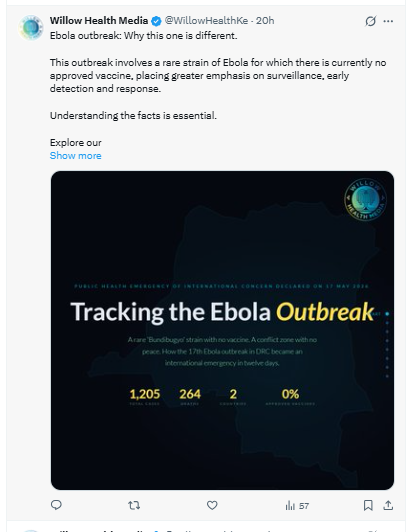
According to Willow Health Media, in a post shared on its X account on Wednesday, June 2, 2026, the current outbreak is linked to a rare Ebola strain for which there is no approved vaccine, increasing dependence on surveillance systems and containment measures.
You Might Also Like



The outbreak has raised concern in the region after reports showed rising infections and deaths within a short period, highlighting how quickly Ebola situations can escalate.
Symptoms can resemble common illnesses
Bulimo warned that one of the major challenges with Ebola is that early symptoms often resemble ordinary illnesses, making diagnosis difficult without laboratory testing.
“It makes you feel weak, it makes you cough,vomit and all other things. You may not tell the difference between Ebola and other common diseases,” he said.
This comes as recent health reports raised concern over increased regional risk in neighbouring countries, including the Democratic Republic of Congo (DRC), where authorities have continued monitoring outbreaks and strengthening response mechanisms.
According to recent Ministry of Health and World Health Organisation information, common symptoms include fever, severe fatigue, headache, muscle pain, vomiting, diarrhoea and abdominal pain. Severe cases may later develop unexplained bleeding and complications affecting different body systems.
DRC alert raises preparedness focus
Recent reports have also shown that DRC and Uganda remain among countries on high-risk alert after confirmed cases emerged, increasing concerns over preparedness in neighbouring countries due to growing regional movement and trade links.
“So once it is tested and it is proved that you are Ebola, then we say you are a confirmed case,” Bulimo added.
Health authorities continue to emphasise that preparedness and factual information remain critical in limiting panic and preventing further spread, warning that communities should rely on official health guidance rather than speculation.
Author
Latest News








Advertisement
More on News