Ebola epidemic: WHO says Congo outbreak spreading faster than response capabilities
By Aloys Michael, June 30, 2026The World Health Organisation (WHO) has issued one of its strongest warnings yet over the escalating Ebola outbreak in the Democratic Republic of the Congo (DRC), saying transmission is now spreading faster than health authorities can contain it despite months of intensive response efforts.
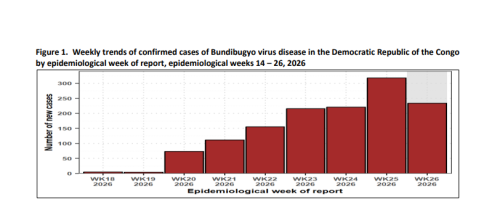
In its latest weekly external situation report released on Tuesday, June 30, 2026, WHO said confirmed Ebola cases in the DRC surged by 24.7 per cent in just one week, while deaths climbed by 41.2 per cent, underscoring the growing pressure on health systems battling the Bundibugyo virus disease (BVD) outbreak.
The agency warned that the epidemic is expanding geographically and stretching treatment capacity close to its limits.
“The BVD outbreak continues to expand at a pace that exceeds current response capacity. While operational gains have been made, overall response performance remains below the level required to rapidly interrupt transmission,” the report reads in part.
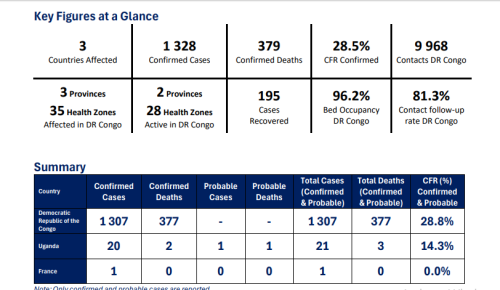
The warning comes after the DRC reported 259 new confirmed Ebola cases between June 21 and June 28, 2026, bringing the cumulative total to 1,307 confirmed infections and 377 deaths, representing a case fatality rate of 28.8 per cent.
During the same period, the outbreak spread into Mandima Health Zone in Ituri Province, increasing the number of affected health zones to 35 since the epidemic began.
Although seven health zones have gone more than three weeks without reporting new infections, active transmission continues across 28 health zones, with Ituri Province accounting for nearly 90 per cent of all recent cases. Bunia, Rwampara and Mongbwalu remain the worst-hit hotspots, collectively driving much of the country’s recent surge in infections and deaths.
WHO said the sharp rise in infections is placing unprecedented strain on treatment facilities. Across the DRC, 654 Ebola treatment beds have been established, yet occupancy has climbed to 96.2 per cent, leaving little room for additional patients.
The situation is particularly difficult in North Kivu Province, where treatment centres are operating at 138.8 per cent occupancy, indicating demand has exceeded available capacity.
“The overall risk remains very high in the Democratic Republic of the Congo, with transmission continuing at a scale that exceeds current response capacity,” WHO warned, pointing to sustained transmission across the Bunia-Rwampara-Mongbwalu corridor and other affected health zones. The agency also noted that North Kivu’s significantly higher fatality rate may reflect delays in diagnosis and access to life-saving care.
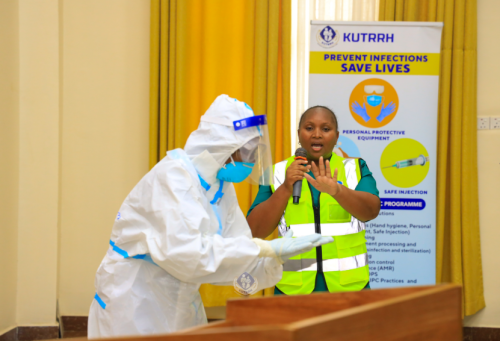
Despite significant investments in surveillance, laboratory expansion and emergency coordination, WHO says critical gaps remain in one of the outbreak’s most important containment tools-contact tracing.
As of June 28, health authorities were monitoring 9,968 identified contacts across affected provinces. However, only 81.3 per cent had been successfully reached within the previous 24 hours, meaning nearly one in five contacts could not be monitored on any given day.
WHO cautioned that these missed follow-ups increase the likelihood of undetected infections and continued community transmission, particularly in Ituri and North Kivu provinces.
The agency acknowledged that important progress has been made since the outbreak began. Laboratory testing has been decentralised to additional locations, treatment capacity has expanded, more than 8 million examination gloves and thousands of diagnostic kits have been delivered, while surveillance at border crossings has also been strengthened.
African governments and international partners have additionally pledged approximately Ksh116 billion to bolster the response, although WHO stressed that the funds must be rapidly converted into operational support on the ground.
Nevertheless, the outbreak continues to generate international concern. WHO recently confirmed an imported Bundibugyo Ebola case in France involving a physician returning from Ituri Province, while Uganda remains vulnerable because of constant cross-border movement along major trucking corridors linking the two countries.
According to WHO, the French case demonstrates that international exportation risk persists, reinforcing the need for stronger surveillance beyond Central Africa.