Ebola crosses into Europe as WHO warns international spread risk remains high
By Aloys Michael, June 30, 2026A confirmed Ebola case in France has heightened international concern over the expanding Bundibugyo virus disease (BVD) outbreak in Central Africa, with the World Health Organisation (WHO) warning that the incident demonstrates the virus is no longer solely a regional health emergency.
In its latest external situation report released on Tuesday, June 30, 2026, WHO said the imported infection confirms that international exportation risk persists, urging countries to strengthen traveller surveillance, cross-border coordination and preparedness as the outbreak continues to intensify in the Democratic Republic of the Congo (DRC).
French health authorities notified WHO on June 24, 2026, of a laboratory-confirmed Ebola case caused by the Bundibugyo virus in a middle-aged physician who had spent five weeks caring for patients in Ituri Province, the epicentre of the outbreak in eastern DRC.
According to the report, the doctor developed symptoms before returning to France and immediately informed airport health officials upon arriving at Charles de Gaulle Airport on June 23. He was swiftly isolated and transferred to a specialised high-containment treatment facility.
“The imported case reported in France further confirms that international exportation risk persists, requiring strengthened surveillance, traveller awareness, and cross-border coordination,” WHO said in its latest assessment.
The agency stressed that the French patient remained clinically stable at the time of reporting and that comprehensive contact tracing had been launched to identify anyone who may have been exposed. Officials said the patient did not experience vomiting, diarrhoea or haemorrhagic symptoms during the journey, reducing the likelihood of transmission while travelling.
Although France’s case has attracted global attention, WHO cautioned that the far greater concern remains the rapidly expanding outbreak inside the DRC, where transmission continues to outpace the current response.
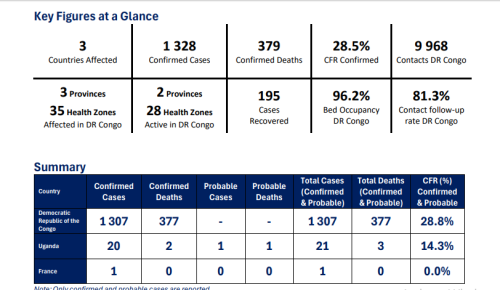
As of June 28, the DRC had recorded 1,307 confirmed Ebola cases and 377 confirmed deaths, representing a fatality rate of 28.8 per cent. During the latest reporting week alone, confirmed infections increased by nearly 25 per cent, while deaths rose by more than 41 per cent, highlighting the speed at which the outbreak is spreading.

“The overall risk remains very high in the Democratic Republic of the Congo, with transmission continuing at a scale that exceeds current response capacity, particularly across the Bunia-Rwampara-Mongbwalu corridor in Ituri Province. Treatment facilities are also approaching capacity, with overall bed occupancy reaching 96.2 per cent and facilities in North Kivu operating above capacity,” WHO warned.
The international implications extend beyond Europe. Uganda, which has already reported 21 cases linked to the outbreak, remains highly exposed because of constant movement across its long border with eastern DRC.
Ebola crisis
WHO noted that the country’s latest confirmed patient was a truck driver travelling along the DRC-Uganda transport corridor. The individual developed symptoms before crossing into Uganda and was isolated shortly after arriving in Kampala, illustrating how commercial transport routes continue to create opportunities for cross-border transmission.
“Uganda remains exposed through sustained population movement from eastern Democratic Republic of the Congo, including trucking routes and possible informal cross-border movement linked to border closures,” the agency stated.
In response, authorities in both countries have expanded surveillance at airports, border crossings and internal transit routes. Uganda continues to require digital passenger locator forms for incoming travellers while maintaining screening at high-risk border points and temporary holding facilities for travellers considered at elevated risk. Temporary travel restrictions between Uganda and the DRC also remain in place.
WHO has also reinforced guidance for countries hosting large international gatherings, advising organisers in affected regions to postpone events until transmission is interrupted.
Elsewhere, it recommends risk assessments, symptom screening, traveller awareness campaigns and follow-up surveillance for at least 21 days after major events involving people arriving from affected areas.
Despite expanded laboratory networks, additional treatment centres and improved contact tracing, WHO concluded that the outbreak remains ahead of response efforts.
“The BVD outbreak continues to expand at a pace that exceeds current response capacity,” the agency said, adding that the French case calls the need for sustained international support and rapid implementation of pledged resources before further exported infections emerge.