Advertisement
DNA sampling to boost kidney transplant tech
Monday 09th March, 2020 12:00 AM|
Clifford Akumu
Every week, patients suffering from kidney failure queue at referral and county facilities for dialysis.
But the biweekly sessions induce nausea, are expensive and taxing to the patients and the country.
For hundreds of patients forced to seek the services in neighbouring counties, it is even more expensive.
You Might Also Like



When the dialysis machines develop mechanical challenges, some patients have to wait for months. Kidneys filter excess water and waste from the blood.
Chronic kidney disease renders the organs unable to perform these tasks requiring renal therapy in the form of a transplant or dialysis.
High blood pressure and diabetes are the major causes of kidney diseases. Global burden now stands at 850 million and 2.4 million people die every year worldwide from kidney related diseases, statistics show.
In Kenya, kidney disease burden stands at five million, with about 4,300 Kenyans undergoing dialysis in 151 centres across the country according to the National Health Insurance Fund.
Dr John Ngigi, Head of Renal Unit at Kenyatta National Hospital, says that changes in lifestyle and eating habits are to blame for the rise in diabetes and high hypertension.
“The commonest cause of kidney failure in our population is chronic kidney diseases (CKD). We have noticed that many patients above the age of 45 have developed kidney failure as a result of diabetes and hypertension requiring them to go for dialysis,” he says.
For younger age groups 18-40 years, have chronic kidney disease as a cause of kidney failure. “But there are other causes of kidney failure that we see in this group including obstruction from prostate or cervical cancer,” adds Ngigi.
Several patients need new kidneys, but the transplants are costly and inaccessible due to donor apathy.
In 2018, Kenyatta National Hospital announced that 2,000 people were on its waiting list for kidney transplants. But the hospital only conducts about 15 transplants a year.
But as we mark the national kidney month, kidney disease patients in Kenya have a reason to be hopeful.
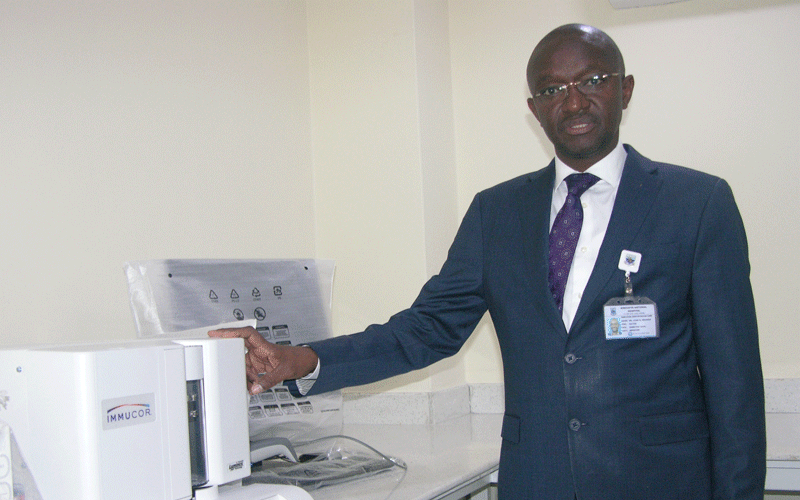
Now, a new DNA sampling technology is set to change all that. The technology will be based at Kenyatta National Hospital.
When the first successful kidney transplant was performed in Boston, the United States of America among twins in December 1954, it was a breakthrough in the field of transplantation.
That discovery, notes Ngigi, has transformed the kidney transplantation terrain and opened new treatment avenues.
The search for new technology led doctors to further enhance kidney transplantation by venturing into Deoxyribonucleic acid (DNA) sampling technology on people who are not related.
DNA is a molecule that contains the biological instructions that make each species unique.
According to the Ministry of Health, only 466 patients have undergone transplants since 2006 in public and private hospitals in Kenya. But all is not lost, explains Ngigi.
“The machine that uses Luminex technology is a first of its kind in the country.
It is aimed at reducing the cost of examining patients by almost 96 per cent since it will ease the process of testing the compatibility of a donor and recipient,” says Ngigi.
Prior to the acquisition of the machine by the government, through the East Africa Development Bank and East Africa Kidney Institute, the country would send the tests to South Africa and India.
But this was an expensive and tedious process gobbling up to Sh70,000-80,000 for a kidney transplant and a major constraint in the transplantation process.
Since South Africa has the necessary equipment, transplantation is conducted within the country hence the process takes a very short time. But in Kenya, the same process can takse up-to two months.
“Time is consumed in running these tests abroad. Our aim is to be efficient in our transplantation processes like in India and South Africa,” adds Ngigi.
He explains that the new machine will reduce cost of the tests drastically to about Sh30,000 through subsidies from the government. It will also take less than two weeks to get the results.
“The machine will serve the entire East Africa, and hasten the process of testing compatibility to facilitate kidney transplants in respective countries,” says Ngigi.
Often many transplant patients end up undergoing expensive dialysis after donors pull out at the last minute.
Ngigi notes that it will increase access to transplantation to kidney patients as an alternative for dialysis. Undergoing dialysis puts a huge financial burden on patients.
“Every month, patients spend around Sh80,000 for dialysis. NHIF pays Sh9,500 per session yet most patients require two sessions thus end up paying out of pocket.
In addition, there other costs such as buying medication to boost haemoglobin levels. Kidney disease patients tend to have low haemoglobin,” Ngigi explains.
Currently, KNH has about 180-200 patients on chronic immune dialysis and 50 per cent of them are eligible for a transplant (about 100 patients).
But lack of donors, money and patient awareness hinders the process.
Over the last 10 years, the referral facility has successfully transplanted almost 205 patients. It costs between Sh500,000-600,000 to do kidney transplantation at the KNH.
Tests on the DNA sampling technology are run using blood samples collected from the donor and recipient. DNA samples are extracted from both to test for compatibility.
“We then test whether the recipient might have developed antibodies against the donor. At this point, we know for sure that the two are a match,” say Ngigi.
Patients with autoimmune conditions such as lupus are not eligible for a transplant.
“Those who cannot undergo a transplant are enlisted for dialysis and encouraged to continue with the programme,” he adds.
The only challenge to transplantation is that patients must continue taking immunosuppressants, medication that pacifies the body’s immune system reaction to the new organ, reducing chances that it will be rejected.
The drugs are required for as long as the patient has the transplant, which remains viable for an average time of 12 years. The only challenge currently, Ngigi says, is that the NHIF does not cover that cost.
The health fund pays Sh500,000 for a transplant, but not for the life-long immunosuppressive drugs needed after the process.
These drugs are expensive, at an estimated cost of Sh40,000 a month in public hospitals, which is too costly making most patients opt for dialysis.
“I hope that NHIF will deem it fit to pay for immunosuppressants because if they do not take these drugs the kidneys will be rejected and then they go back to dialysis which is expensive,” he says.
He notes that the secret to increasing the number of transplants lies in improving the transplantation process.
KNH has embarked on upgrading the renal unit upgrade to include liver transplants.
The upgrade aims to increase the volume of transplants at the unit to over hundred per year.
Author
People Reporter
View all posts by People ReporterLatest News








Advertisement
More on News