Catholic bishops fault SHA, CBE rollout, warn over corruption and rising disregard for life
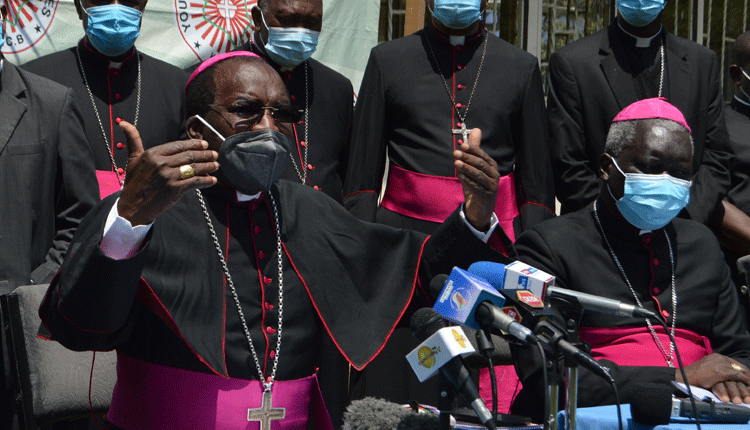
By Kenneth Mwenda, April 16, 2026The Kenya Conference of Catholic Bishops (KCCB) has stepped up pressure on the government, raising fresh concerns over the state of healthcare, education, governance and public morality.
In a strongly worded message, on Thursday, April 16, 2026, the bishops warned that delays in health payments, gaps in the Social Health Authority (SHA), and poor rollout of the Competency-Based Education (CBE) system are putting lives and livelihoods at risk.
Health system gaps exposed
The bishops said the transition to SHA continues to face serious operational challenges, particularly in the processing of claims. They pointed to confusion around rejected and returned claims and questioned the role of the Digital Health Authority (DHA) in the process.
“The role of the Digital Health Authority in the SHA processes, especially concerning rejected and returned claims, needs to be clarified,” the bishops said.
They warned that unresolved inefficiencies, including system downtimes and underfunding, are affecting service delivery and could undermine access to care.
“We believe it is within the power of the government to look into this problem and provide a long-lasting solution, as this situation undermines the protection of human life and dignity,” they added.
The bishops urged the government to act quickly and fix structural weaknesses in the health system. They said continued delays risk harming patients who depend on timely and affordable medical services.
“We should not continue going in circles at the expense of human life in need of medical care,” the statement read.
Their remarks come against the backdrop of concerns over billions of shillings owed to faith-based health facilities and ongoing complaints about the efficiency of the new health insurance framework.
CBE under scrutiny
On education, the bishops criticised the rollout of the Competency-Based Education system, saying it was poorly planned and executed. They argued that the shift from the 8-4-4 system has exposed major gaps in design and implementation.
“The system seems poorly thought out and is being poorly implemented,” they said.
The clerics warned against turning learners into subjects of constant experimentation, noting that the government had enough expertise to prepare adequately before rolling out the system.
“We cannot place our children in a constant mode of experimentation,” they said.
While acknowledging that CBE was introduced to promote practical skills, creativity and critical thinking, the bishops argued that it has turned out to be resource-intensive. They said schools are struggling due to shortages of teachers, equipment and funding.
“As we have come to know it, CBE is capital intensive. It requires more teachers, equipment and financing,” they said.
They called on the Ministry of Education to urgently set up a multi-sectoral team to review and streamline the system.
“We urge the Ministry of Education to urgently constitute a multi-sectoral team to study, properly evaluate and clearly design how the CBE system should operate,” they added.
The bishops also raised concern over what they described as attempts to reduce the role of sponsors in schools. They insisted that sponsors play a key role in maintaining values and ethical standards in education.
Corruption and impunity
Beyond policy issues, the bishops took aim at corruption, describing it as a major threat to the country. They warned that greed and graft have become normalised in society.
“Corruption continues to be a major threat to human life in our country. We Kenyans seem to have normalised greed and corruption,” they said.
They criticised what they described as a lack of political will to tackle the vice, warning that impunity at the top fuels wider abuse of public resources.
“The goodwill to fight corruption from the top is waning,” they said.
The bishops linked corruption to broader social problems, including land grabbing, misuse of public funds and the rise of cartels. They cited recent cases where religious institutions have faced attempts to lose land, describing them as a sign of weak enforcement of property rights.
They urged citizens to take responsibility and reject corrupt practices at all levels.
“We must break the chains of corruption. We must refuse to be part of this axis of evil,” they said.
Moral concerns and social stability
The bishops also addressed wider social issues, including the defence of the family unit and the need to uphold moral values. They said families remain the foundation of a stable society and should be protected.
“Our families are the cradle of life and the base of a stable and balanced society,” they said.
However, they raised concern over challenges in civil marriage registration, citing delays and inefficiencies in obtaining certificates. According to the bishops, the process has become slow and discouraging for couples seeking to formalise their unions.
They called for reforms to make the process more efficient and accessible.