Advertisement
Calls to end stigma against people with haemophilia
Thursday 22nd April, 2021 12:00 AM|
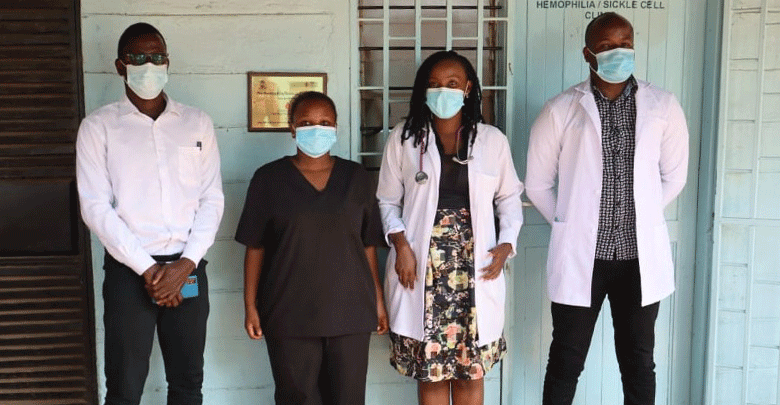
The small but well-lit spacious room that houses haemophilia and sickle cell clinic at the heart of Moi County Referral Hospital in Voi in Taita Taveta County is devoid of noise but a ray of hope to blood disorder patients.
Patients with potentially deadly blood disorders come here for enhanced treatment. Standing along the wall is a locked five-foot fridge with a transparent door. Inside are a dozen white packets and two small bottles with clear liquid.
The packets contain factor concentrates; life-saving substance intravenously administered to patients with Hemophilia.
“A packet can go for as much as Sh250,000. Depending on one’s condition, a patient might need as many as 14 or 15 packets weekly,” explains Dr Jeremiah Shem, a general practitioner.
Haemophilia is an inherited blood disorder, mostly from mother to child, characterised by long episodes of bleeding.
Patients lack a protein that triggers the clotting process. This condition usually affect men and can be fatal if not swiftly managed.
Major milestone
The Haemophilia clinic is regarded as a major milestone towards promotion of access to Universal Health Care.
Clinic has also brought the much-needed relief to patients and saved them a fortune spent while seeking medical help in hospitals in Nairobi and Mombasa.
Currently there are nine local haemophilia cases being managed at the clinic. Dr Shem says there are more cases that have not been documented and has appealed to people with blood disorders to come out and receive treatment.
“There are many cases out there that we are not aware of. What we are urging is for everyone with bleeding disorder to come out and get help,” he said.
Haemophilia occurs in one for every 10,000 people. According to Kenya Hemophilia Association, there are approximately 750 known cases from 4,500 people living with the condition in Kenya.
The significant proportion of people who fear coming out publicly is attributed to stigma associated with a condition.
Dr Rebeccah Mwakichako, a medic who treats hemophilia and sickle cell patients, says there is an urgent need to destigmatise haemophilia to encourage more people to come out and seek treatment.
She noted that the condition can be managed with blood clotting factors. “This is one blood disorder not much known like other ailments. The public views and perceptions make it hard for people with such disorder to come out,” she explained.
As part of a campaign to increase the awareness on haemophilia, doctors are establishing partnerships with churches and other religious groups to enhance monitoring of such conditions, especially when churches are conducting mass circumcision for boys who have come of age.
Mwakichako says the partnership will enhance medical assessment of young boys and eliminate the risk of conducting circumcisions on potentially haemophilic boys.
She noted that such partnerships would help medics identify potential cases of interest. The initiative will also create more awareness of the condition amongst the church members.
“We can learn if there exists a history of prolonged bleeding in the family and thereby make necessary follow up,” she said.
Though still young, the haemophilic clinic made history after conducting the first safe surgery circumcision for a hemophilic boy in the Coast region.
Dr Shem, who oversaw the operation, said the young boy was traumatised by constant ridicule from other boys to an extent that he was mulling suicide.
Dr Shem disclosed that the operation went on well and the boy is now in high school.
“It was a big relief for everyone- the boy, his father and other family members. We managed his condition throughout the process until he was well,” he said.
He added that with the arrival of Covid-19 vaccine, medics were encouraging hemophilic patients and other people with blood disorders to receive their jabs from the facility to mitigate against risk of excessive bleeding.
Dr Shem noted that with the government’s push for Kenyans to get the Covid-19 vaccine, there was a mordant risk of hemophilic cases getting injected and triggering emergency bleeding thus the need to be injected in secure facilities.
“People are taking the injections, but those with bleeding disorders ought to do it from the facilities where the risk of bleeding excessively can be mitigated,” he said.
Other hemophilia treatment centres are found at the Kenyatta National Hospital, Murang’a Level 5, Kisii Teaching and Referral Hospital and at the Coast Provincial General Hospital.
Treatment centres
Efforts of the Moi County Referral Hospital Hemophilia clinic have not gone unnoticed.
Already, Kenya Haemophilia Association is exploring the possibility of upgrading the clinic into becoming a center of excellence for treatment and management of hemophilia and other blood disorders in the region.
Once the clinic is upgraded, it will receive equipment for conducting blood analysis to determine the missing factor in a patient.
One of the major challenges in management of hemophilia is the treatment cost. Currently, the factor concentrates available for use by hemophilia patients are provided by donors.
Among the major donors are Novo Nordisk Haemophilia Association and World Federation of Haemophilia.
Mwakichako says inherited blood disorders like hemophilia and sickle cell remain the most expensive to manage.
“The drugs and treatment is prohibitively high for patients who are financially challenged. The government should step in and make this treatment free,” she said. – KNA
Author
People Daily
View all posts by People DailyLatest News





Advertisement
More on News