Advertisement
Caleb Amisi urges Kenya to close its airspace as US–Iran war escalates
Saturday 28th February, 2026 04:09 PM|

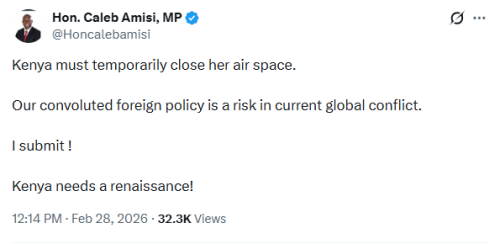
Saboti Member of Parliament Caleb Amisi has ignited a national debate after stating that Kenya must temporarily close its airspace due to escalating global conflict risks.
Amisi, who sits on the House Foreign Relations and Defence Committee, posted his direct warning on X on Saturday, February 28, 2026, after the United States and Israel launched coordinated strikes against Iran.
“Kenya must temporarily close her airspace. Our convoluted foreign policy is a risk in the current global conflict. I submit! Kenya needs a renaissance!”
A rapid escalation in the Gulf
In coordinated operations, the United States and Israel struck targets across Iran, including Tehran, Isfahan, Qom and Karaj. President Donald Trump announced the start of what he termed “major combat operations” aimed at dismantling Iran’s nuclear and missile programmes, weakening its military capability, and enabling political change inside the country.
You Might Also Like

“We are going to destroy their missiles and raze their missile industry to the ground,” Trump said.
Israeli forces reportedly targeted high-level leadership compounds tied to Iran’s supreme leader, president and senior armed forces commanders.

Iran responded swiftly with ballistic missile attacks. Missiles struck Israel directly and targeted US military installations across the Gulf. Bahrain confirmed an attack on the US Fifth Fleet headquarters in Manama, with smoke seen rising over the Juffair area.
Explosions and air defence interceptions were reported near Al Udeid Air Base in Qatar, Ali Al Salem Air Base in Kuwait, and Al Dhafra Air Base in the UAE. Sites in Riyadh, Abu Dhabi and Dubai also activated air defences. In Abu Dhabi, one person reportedly died from falling missile debris despite interception efforts.
Gulf states condemned the strikes as violations of their territory and scrambled defensive systems. The scale and speed of the escalation exceeded the shorter June 2025 confrontation, which had remained comparatively contained. Iran described the joint US-Israeli assault as an existential threat and launched its counter-strikes with little prior signalling.
Why Kenya is in the conversation
Kenya maintains open airspace for commercial and certain military traffic. It partners with the United States on security training, cooperates with Israel on counter-terrorism, and simultaneously maintains economic ties with China and Russia.
Amisi describes this approach as convoluted, a blending of competing alliances that, in his view, increases vulnerability during global conflict.
His concern is strategic. In times of war, military aircraft, drones, logistics planes, or support flights may alter routes to reach or avoid conflict zones. Kenyan airspace, positioned along key intercontinental corridors, could theoretically serve as a transit route. That exposure, Amisi argues, risks accusations of bias, diplomatic fallout, or even unintended incidents.
A temporary closure, he suggests, would reduce those risks. It would allow the government to reassess commitments, tighten air traffic controls, and clarify Kenya’s diplomatic stance without appearing aligned to any warring bloc.
Kenya alerts citizens in Qatar
The concerns come as Kenya has already begun responding diplomatically to the unfolding crisis. On Saturday afternoon, the Kenyan Embassy in Doha issued an advisory urging Kenyans in Qatar to remain calm amid explosions and air defence activity following Iran’s missile strikes targeting US facilities, including Al Udeid Air Base.
Foreign Affairs Principal Secretary Korir Sing’Oei said Nairobi was closely monitoring developments and maintaining communication with diplomatic missions in the region, calling for caution and de-escalation.
Author
Kenneth Mwenda
Kenneth Mwenda is a business, sports, and politics digital writer with over seven years of experience in journalism, covering breaking news, feature stories, and in-depth analysis across a range of beats.
For inquiries, he can be reached at [email protected]
View all posts by Kenneth MwendaLatest News








Advertisement
More on News