Africa’s population growth outpaces wealth creation, report warns
By Aloys Michael, May 9, 2026Sub-Saharan Africa is projected to become one of the world’s fastest-growing economic regions over the next five years.
Yet, the continent will still account for only a tiny fraction of global wealth creation, exposing what the World Economic Forum (WEF) describes as a growing imbalance in the new global economy.
According to the WEF’s 2026 report, Growth in the New Economy: Towards a Blueprint, Sub-Saharan Africa is expected to post annual economic growth of 6.1 per cent between 2025 and 2030. Despite its rapidly expanding population and youthful workforce, the region will contribute just 4.7 per cent of cumulative global GDP growth during that period.
The report paints a troubling picture for Africa’s long-celebrated demographic advantage, warning that population growth alone is not translating into proportional economic power, industrial expansion or technological influence.
“Old growth strategies in the new economy are unlikely to yield returns, and may even erode past gains,” the report states, adding that “the new economy calls for an agile new blueprint for growth.”
The findings come at a time when African governments, including Kenya, are aggressively marketing themselves as emerging digital and industrial hubs capable of benefiting from the global shift toward artificial intelligence, advanced manufacturing and green energy.
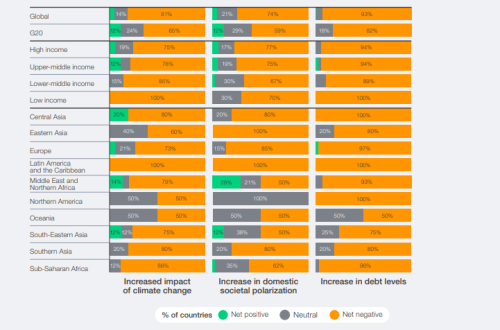
Yet the WEF report suggests Africa risks remaining trapped on the margins of global wealth creation as growth continues concentrating in Asia and middle-income economies.
The report projects that middle-income economies will account for 65 per cent of global GDP growth by 2030, while Asia alone will contribute more than half of global expansion.
In contrast, low-income countries, many of them in Africa, are expected to jointly contribute only 1 per cent of global growth despite accounting for around 8 per cent of the world’s population.
WEF identifies several barriers slowing Africa’s transition from population growth to productivity-driven prosperity, including weak infrastructure, limited access to finance, policy instability and high energy costs.

Limited financial access
In Sub-Saharan Africa, 88.5 per cent of countries surveyed cited limited access to finance for business investment as one of the biggest obstacles to accelerating growth.
More than half also flagged inadequate infrastructure and rising energy costs as major barriers.
For Kenya, the report raises uncomfortable questions about whether the country’s ambition to become East Africa’s Silicon Savannah can deliver meaningful industrial transformation or merely produce skilled labour for wealthier economies.
Kenya has built a strong reputation in fintech, digital banking and mobile money innovation, but manufacturers and businesses continue to grapple with expensive electricity, infrastructure deficits and shifting tax policies that investors say undermine long-term planning.
The WEF report warns that countries unable to build the capacity to absorb, adapt and apply innovation risk falling behind as technology increasingly becomes the main driver of global value creation.
“Technology and knowledge are increasingly central to value creation,” the report says, noting that economies that fail to strengthen productivity and human capital could see widening inequality and slower development.

The study also notes demographic shifts as one of the biggest factors shaping future growth trajectories.
While ageing populations are expected to drag down growth in Europe and East Asia, expanding youth populations in Sub-Saharan Africa and South Asia are viewed as potential drivers of future consumption and labour supply.
However, economists warn that without sufficient investment in education, industrialisation, and job creation, Africa’s youth boom could deepen unemployment, migration pressures and inequality instead of delivering prosperity.
The report further cautions that global economic fragmentation and the concentration of frontier technologies in a handful of countries could widen the gap between advanced economies and developing regions.
“The winners in the new economy will be those who understand competing threats and opportunities and build agile growth pathways,” the WEF states.
For African economies, the challenge may now be less about how fast populations grow, and more about whether that growth can finally generate real wealth, industrial power and global economic influence.