African Union condemns coordinated attacks in Mali
By Kenneth Mwenda, July 5, 2026The African Union Commission has condemned a wave of coordinated attacks that hit multiple towns across Mali on 4 July 2026, warning that terrorism continues to threaten stability in the Sahel region. The statement comes after Mali’s army reported simultaneous assaults in the north, central areas, and near the south of the country.
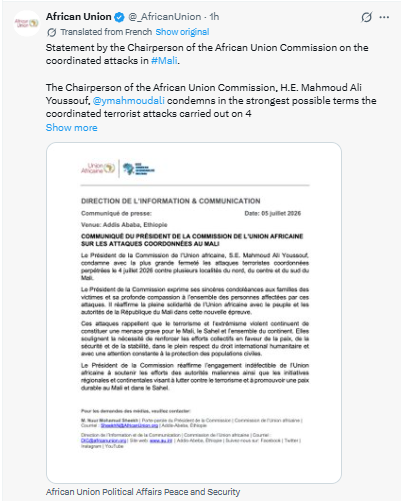
In its official statement released on July 5, 2026, the African Union Commission Chairperson, Mahmoud Ali Youssouf, said he “strongly condemns the coordinated terrorist attacks carried out on 4 July 2026 against several localities across northern, central and southern Mali.”
He added that the AU “extends its sincere condolences to the families of the victims” and stands in “full solidarity with the government and people of the Republic of Mali during this difficult time.”
The attacks targeted several strategic locations, including Aguelhok, Anefis, Gao, Sevare, and Kenieroba. According to Mali’s military, armed groups launched early morning assaults using rockets, gunfire, and coordinated ground movements. Security sources said fighting began around dawn and spread quickly across different regions.
In some areas, the army reported heavy resistance. Officials said 20 fighters described as “terrorists” were killed in Sévaré and six more in Gao. One pro-government fighter died, while several others were injured. The army later claimed that the situation had returned to “totally under control.”
The violence also reached civilian infrastructure. Reports from local sources and international media indicated that a prison in Kenieroba, about 74km from Bamako, came under attack. Residents in multiple towns described explosions, gunfire, and aircraft overhead as fighting intensified.
Sahel security remains fragile
A Tuareg-led armed group, the Azawad Liberation Front, confirmed involvement in parts of the offensive. A spokesperson for the group said its fighters attacked Anefis in the Kidal region, an area where government troops and allied forces, including Russian fighters, have been stationed since earlier clashes in April 2026.
The renewed violence highlights the fragile security situation in northern Mali, where armed groups linked to both separatist movements and extremist networks continue to operate. Over the past decade, Mali has faced repeated insurgencies involving al-Qaeda-linked groups, Islamic State affiliates, and Tuareg separatists who demand an independent state in the north.
The African Union warned that these attacks show the wider threat facing the Sahel. The Chairperson said terrorism and violent extremism “continue to pose a serious threat to Mali, the Sahel and the African continent as a whole.” He stressed the need for “collective efforts to advance peace, security and stability,” while calling for respect for international humanitarian law and protection of civilians.
The attacks reflect ongoing pressure on Mali’s military government, which has struggled to restore control despite repeated operations and foreign security partnerships. The spread of violence from the north to central and southern regions shows how armed groups can still coordinate across long distances.
The AU reaffirmed its commitment to support Mali’s authorities and regional initiatives aimed at countering terrorism. It said it will continue working with African partners to promote long-term stability in the Sahel.