2 Kenyans arrested in Tanzania protests released
By Joel Masibo, November 9, 2025The Kenyan High Commission in Tanzania has confirmed the release of two Kenyans who were arrested in the post-election protests in Tanzania, a crisis that has claimed hundreds of lives and resulted in dozens of people being apprehended.
Protests erupted on Wednesday, October 29, 2025, shortly after Tanzania conducted its general election exercise, as civilians protested against the harsh treatment of opposition leaders by the state when President Samia Suluhu sought to retain her seat while her closest challengers were behind bars.
Among the protesters who were arrested were lawyer Fredrick Lorent Obuya and John Gitahi Nderitu, a financial practitioner. Reports of their arrest prompted uproar in Kenya as families, friends and human rights defenders demanded the immediate release of Kenyan nationals held by Tanzanian authorities amid the political unrest in the country.
Following the call and the mounting pressure from Kenya, the Kenyan High Commission in Tanzania announced that Ambassador Isaac Njenga received the two on Saturday, November 8, 2025.
Free at last
”The High Commissioner, H.E. Ambassador Isaac Njenga, received two Kenyans who had been arrested in Tanzania following the protests of 29th October 2025 during the General Elections. Mr Fredrick Lorent Obuya, a lawyer and tour operator, and Mr John Gitahi Nderitu, a financial professional, were released without charges to the custody of the Kenya High Commission in Dar es Salaam. They thanked the mission & looked forward to reuniting with their families,” the commission said in a statement.
The release of Njenga and Obuya comes at a time when human rights organisations had condemned the Tanzanian government over the killing and unlawful detention of Kenyan nationals, describing the incidents as grave violations of human rights and international law.
In a joint press statement issued in Nairobi on Friday, November 7, 2025, VOCAL Africa, Defenders Coalition, and Amnesty International Kenya expressed deep outrage over what they termed as “ongoing violence, human rights violations, and the breakdown of the rule of law” in Tanzania following its disputed elections.
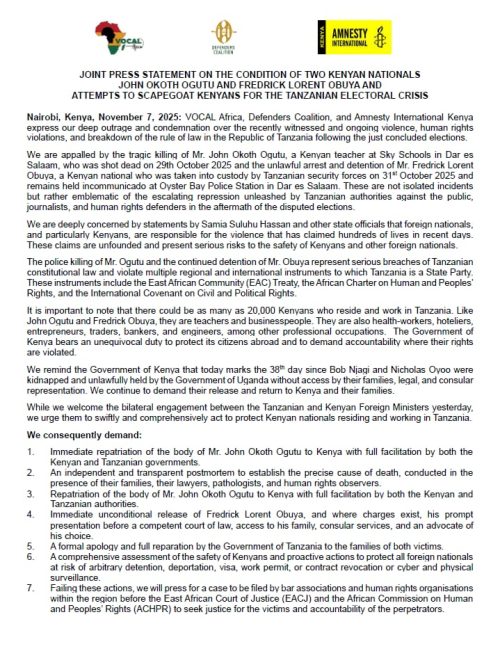
The statement cited the tragic killing of John Okoth Ogutu, a Kenyan teacher at Sky Schools in Dar es Salaam, who was allegedly shot dead by Tanzanian security forces on October 29, 2025. It also condemned the unlawful arrest and detention of Fredrick Lorent Obuya, another Kenyan national who was taken into custody on October 31, 2025, and has since been held incommunicado at the Oyster Bay Police Station in Dar es Salaam.
“These are not isolated incidents but part of escalating repression unleashed by Tanzanian authorities against the public, journalists, and human rights defenders in the aftermath of the disputed elections,” the organisations stated.
Safety concerns
The groups also expressed concern over remarks attributed to Tanzanian President Samia Suluhu Hassan and other top officials suggesting that foreigners, particularly Kenyans, were to blame for the recent wave of violence in Tanzania. The rights defenders termed these claims as “unfounded and dangerous”, warning that they pose serious risks to the safety of Kenyans and other foreign nationals living and working in Tanzania.
According to the statement, thousands of Kenyans, estimated at up to 20,000, reside and work in Tanzania as teachers, health workers, entrepreneurs, and other professionals. The organisations reminded the Government of Kenya of its obligation to protect its citizens abroad and to demand accountability when their rights are violated.
The coalition further drew parallels with past incidents, noting that it had been 38 days since two other Kenyans, Bob Njiagi and Nicholas Oyoo, were kidnapped and unlawfully detained in Uganda, urging Nairobi to act decisively to prevent a pattern of regional impunity against its citizens.