Plants face heightened risk of extinction, experts warn
By Christopher Owuor, March 10, 2020Milliam Murigi @millymur1
Kenya is considered the richest East African country in biodiversity. The country’s known biodiversity assets include 7,000 plants, 25,000 invertebrates—animals without a backbone (21,575 of which are insects)—1,133 birds, 315 mammals, 191 reptiles, 180 freshwater fish, 692 fish, 88 amphibians and about 2,000 species of fungi and bacteria according to Nema.
However, the rich biodiversity is declining not just locally, but globally at unprecedented rates in human history and the rate of species extinctions is accelerating. Locally, the country is slowly losing its biodiversity, with some species facing the risk of extinction.
Plants species are particularly gradually disappearing. Though extinction is an issue of global concern, Kenya has concentrated most of its efforts in protecting wildlife as compared to plants.
This is despite the fact that a healthy ecosystem depends on both plants and animals.
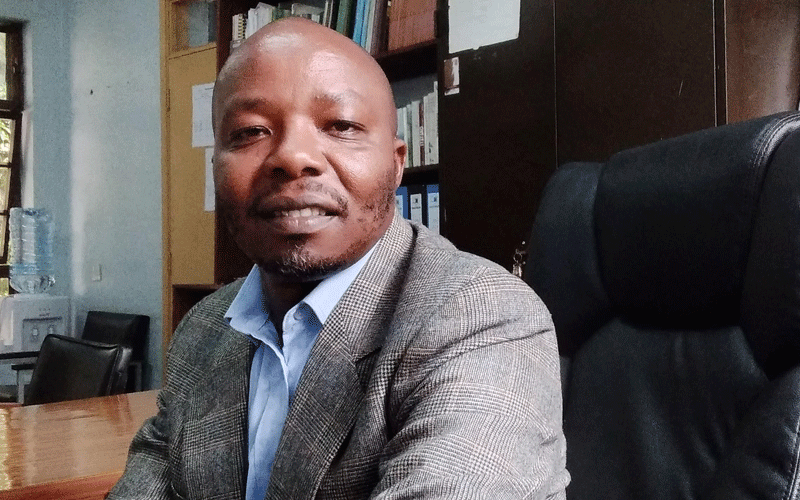
According to Dr Paul Mutuku, a botanist at East African Herbarium and Head Botany Department at the National Museums of Kenya, plant species extinction is an indication of an ecosystem that is slowly falling apart and ultimately all forms of life will be negatively affected.
Lost plants
“Plants play an important role as primary producers of food. They also provide habitat for animals.
Continued extinction of some plants species specifically those relied upon by certain animals for food or shelter may affect energy transfer between organisms.
In the long run it may end up affecting the whole ecosystem, which includes wildlife. It could also destroy habitats where animals live and breed,” he says.
Mutuku says that it is difficult to tell exactly how many plant species have become extinct or at the risk since extinction is a continuous process. Most critically endangered species could be extinct in the near future if nothing is done to salvage them.
It is likely that some plant species have become extinct without public knowledge since they were yet to be discored and their existence was unknown.
In Kenya, some of the lost plants include the Chile sandalwood (Osyris lanceolata), which was exploited for essential oils, Knobwood or Mrungurungu in Kiswahili, African wild olive (Olea europaea subsp.africana), known as muthata in Kikamba and Kiembu.
A 2019 research by a group of scientists from the United Kingdom’s Royal Botanic Gardens, Kew and Stockholm University revealed that almost 600 plant species have gone extinct globally in the past 250 years with the biggest losses being on islands and in the tropics, which are home to highly valued timber trees and tend to be particularly rich in plant diversity.
The number of extinct plants species is twice that of all bird, mammal and amphibian extinctions combined.
The researchers assessed the risk of extinction of more than 20,000 plant species. They found that 33 per cent of the species are potentially threatened with extinction. Another third of species are rare, potentially becoming threatened in the near future.
But if this is the situation, why is the country not creating awareness about the lost plants the same way it has done with animals? Musili says that there is a skewed perception that more focus is given to wildlife at the expense of plants.
The National Museums of Kenya through Directorate of Research is actively involved in biodiversity research for both plants and wildlife.
“Education and awareness around all aspects of the species extinction is needed. Additionally we need research on ecosystems and climate change so as to answer key questions on extinction and offer solutions.
Apart from that, policy change and implementation is critical on conservation and protection of vulnerable species,” says Musili.
David Wakogy, an environmentalist and chairman of the Friends of Ondiri Wetland Kenya, a Community-Based Organisation, innovative measures must be take to stem plants loss.
Wakogy says that in order to effectively stem the loss of plant populations and the associated genetic diversity, the country should prioritise the development of a national plant conservation strategy.
He adds that deforestation, population growth and climate change are some of the major contributions to extinction. People will, therefore, need to devise solutions that target funding towards conservation research and action.
According to Wakogy people should stop asking what biodiversity can do for us rather we should start asking what we can do for biodiversity.
“Plant extinction should be considered a disaster. It has multiplier effects that can lead to a whole cascade of extinctions in other organisms that rely on them.
All life on Earth depends on plants, which provide the oxygen we breathe and the food we eat,” says Wakogy.
Saving tree species
However, as a way of preserving some of these species, World Agroforestry (ICRAF) is preserving some of these trees and shrubs by holding samples of most of the species in its genebank.
The international institute involved in sustainable management of trees also grows these species in plant nurseries at its headquarters in Nairobi. The ICRAF gene bank holds close to 200 species.
Earlier research by Dr Eimear Nic Lughadha, from the Royal Botanic Gardens revealed that there are thousands of “living dead” plant species.
These species have no chance of survival because only one sex of the plants remains or the big animals needed to disperse their seeds are extinct.