Will the protest compensation plan deliver justice
By Faith Lagat, August 10, 2025President William Ruto, on August 8, 2025, issued a presidential proclamation establishing a special framework to compensate victims of demonstrations and public protests in Kenya, including civilians and security personnel harmed since 2017.
The announcement, shared via X, acknowledges the Constitution’s dual obligations to uphold civic responsibility and guarantee freedoms while addressing the tragic outcomes of violent protests.
Signed with the Public Seal of the Republic, the proclamation mandates a 120-day coordination process led by Makau Mutua to provide accountability, redress, and reparations. Yet, as the country reflects on years of state violence, economic unrest, and public mistrust, the question remains: will this plan truly deliver justice?
Framework with historical weight
The proclamation recognises the expanded democratic space since the 2010 Constitution, noting that while this has empowered citizens to demonstrate, some protests have “regrettably turned violent, resulting in bodily harm and loss of life.” The framework targets incidents from 2017 onwards—a turbulent period that includes the 2024 anti-Finance Bill protests, where police killed dozens, according to the International Crisis Group.
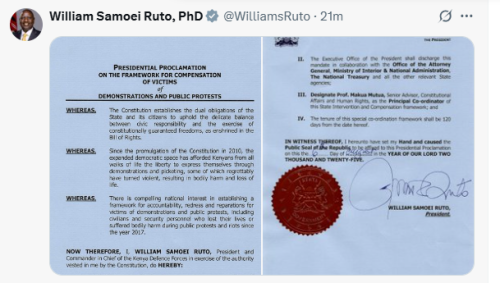
The presidential statement framed the plan as being in the “compelling national interest” to heal wounds and restore trust.
The structure, coordinated by the Executive Office of the President alongside key ministries and the National Treasury, seeks to develop a system to identify victims, process claims, and disburse funds within four months.
The choice of Makau Mutua, a respected voice on human rights, adds a measure of credibility. However, critics argue that the absence of mechanisms to prosecute those responsible for unlawful killings — particularly rogue officers implicated in brutality — limits the framework’s ability to deliver full justice.
Among them is Democracy for Citizens Party deputy leader Cleophas Malala, who has questioned how financial payouts can make up for lost lives. His blunt question, “Ni pesa ngapi inatosha kulipia uhai wa mtoto?” captures the raw pain of bereaved families.
Lessons from past
Kenya’s history with compensation offers both hope and caution. In July 2025, the government paid Ksh16 million to four survivors of the 2007–2008 post-election sexual violence. The Coalition on Violence Against Women (COVAW) hailed the move as historic, yet it came after a 13-year legal battle, with interest unpaid and four other survivors excluded from the settlement.
Treasury Cabinet Secretary John Mbadi, speaking on August 8 at a burial ceremony in Homa Bay County, pledged swift disbursement for protest victims as part of a “chapter of the rule of law and respect for human rights.”
While encouraging, similar promises in the past have been undermined by slow bureaucratic processes and political interference. Without complementary legal action against those responsible, such gestures risk being seen as public relations exercises rather than substantive reforms.
Economic grievances have been a consistent driver of Kenya’s protest culture. The World Bank reported in 2023 that 60 per cent of government revenue goes to debt servicing, deepening public frustration.
The 2024 anti-tax protests left over 60 people dead and hundreds injured, according to human rights groups. The framework’s inclusive scope, covering both civilians and security personnel, may appear even-handed, but without accountability for orders and actions that led to violence — including instances where leaders encouraged excessive force — trust will remain fragile.
Public reaction on social media reflects this scepticism. Some Kenyans have called the plan inadequate, pointing to past abductions and extrajudicial killings documented by Amnesty International.
The images of tear gas, injured protesters, and grieving families that resurfaced after the proclamation stand in stark contrast to its formal, measured tone. Malala’s warning that “compensation without reform will see police continue to kill our youths in the streets” underscores the urgency of coupling financial payouts with institutional change.
The 120-day test
The 120-day mandate gives the framework a narrow window to prove it can deliver. If it produces fair, transparent compensation and initiates prosecutions, it could mark a turning point, building on precedents such as the 2020 African Union Court ruling awarding reparations to the Ogiek community. Yet caution is warranted.
Past court-ordered payments — such as the Ksh100,000 compensation awarded in 2022 to 206 victims of human rights violations — often stalled due to parliamentary approval delays, as highlighted in the U.S. State Department’s 2025 human rights report.
Without legislative backing and clear enforcement mechanisms, the new framework could face similar hurdles. The Truth, Justice and Reconciliation Commission’s findings, for example, remain largely unimplemented because it lacked prosecution powers.
The danger is that this new initiative could follow the same path — acknowledged on paper, celebrated at launch, and quietly shelved thereafter.
For many Kenyans, justice means more than financial compensation. It involves holding individuals accountable for unlawful acts, reforming policing methods, and addressing the economic inequalities that often spark unrest. If the framework is to succeed, it must not only pay victims but also catalyse systemic change. Otherwise, it risks becoming another chapter in a long book of unkept promises.
The framework offers a flicker of hope but also a test of political will. Its success will be judged not by the speeches that launched it, but by the actions that follow — and whether, for once, the cries of victims are met with more than words.