Why Kindiki’s ‘1-1 draw’ narrative doesn’t tell full story of Mt Kenya political battlefield
By Ndiritu Wanjiru, July 18, 2026Deputy President Kithure Kindiki’s assertion that the political contest between the Kenya Kwanza administration and the opposition is now a “1-1 draw” following the Ol Kalou and Mbeere North parliamentary by-elections may be mathematically accurate in terms of seats won, but it fails to withstand scrutiny when the actual voting figures are examined.
Speaking after the declaration of the Ol Kalou by-election results, Kindiki argued that the government had won Mbeere North while the opposition, led by the Democracy for the Citizens Party (DCP), had taken Ol Kalou, insisting that the two sides were now level ahead of the 2027 general election.

But the number of constituencies won is not the sole criterion for measuring elections. The margin of victory can give a better sense of how voters feel and how political momentum and public support are moving.
Contrasting outcomes
The Mbeere North by-election was a close-fought contest. UDA candidate Leonard Wamuthende Muriuki registered 17,536 votes while the Democratic Party (DP) candidate Newton Karish garnered 15,565 votes. As was typical of the competition, the margin of victory for the ruling party was only 1,971 votes.
The results of Ol Kalou were entirely different. The UDA candidate, Samuel Muchina Nyagah, polled 5,450 votes, and the Democracy for the Citizens Party (DCP) candidate, Sammy Douglas Waweru Kamau, polled 35,440 votes, leaving the opposition with a massive 29,990-vote margin.
The two matches are incredibly contrasting. UDA’s win over Mbeere North was by less than 2,000 votes, but its loss in Ol Kalou was closer to 30,000 votes, almost 15 times the difference in votes by which UDA won Mbeere North.
Beyond the seat count
These figures make it difficult to equate the two results as being of the same political weight.
In contrast with Mbeere North, the Ol Kalou became a political matter of high stakes and involved the whole government. President William Ruto; Deputy President Kithure Kindiki; Cabinet Secretaries, Governors, and high-ranking leaders in the United Democratic Alliance (UDA) made several visits to the constituency, making the local by-election a national political test.
In spite of the huge mobilisation, UDA secured just 5,450 votes as compared to DCP’s 35,440 votes, which was one of the most dramatic electoral defeats for the ruling party since it came to power.
Hence, it is incorrect to call the two by-elections in the country a “1-1 draw” because the message voters sent on the overall political issue was missed.
Importance of voting margins
Mbeere North, on the other hand, has demonstrated that UDA can still compete against the ruling party in its traditional strongholds, but Ol Kalou indicated that the opposition, despite the intensive government campaign, can not only buttress the ruling party in the Mt Kenya region but also sweep through it.
The number of victories is not the only measure of political contests. The significance of those victories depends on the size because they show the strength of enthusiasm, confidence and mobilisation of the two sides, respectively.
If a candidate wins by a narrow margin, it often means the race is more competitive than it seems, and if they lose by a large margin, then it may suggest more is going on than just the race in the particular district.
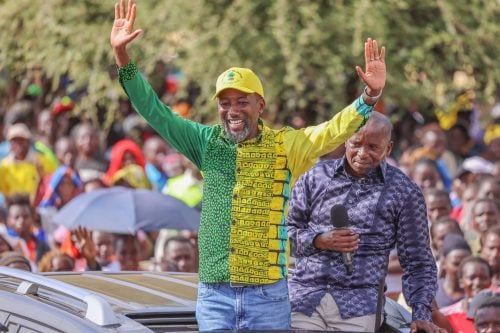
So Kindiki’s “1-1 draw” comparison ends up being an easy way to explain two by-elections that had wildly different outcomes. Though the number of seats can be the same, it’s a very different story.
The Mbeere North by-election proved that UDA can survive a close call, while Ol Kalou showed the opposition could be able to triumph with an overwhelming mandate over the ruling party.
It is that difference in the voting margin between 1,971 and 29,990 that makes the two races apolitically comparable and puts into doubt the Deputy President’s assertion that the government and the opposition are now “evenly matched”.
So far, as political parties adjust to the 2027 General Election, the question of who won one seat each is likely to be far from the discussion.
Instead, it will stay on the magnitude of those wins and the changes in political momentum that they suggest in areas that may be critical in the next national election, especially in the areas where that takes place.