Why Kenya remains off the US immigrant visa ban list
By Aloys Michael, January 18, 2026As Washington tightens its immigration rules, Kenya has quietly emerged as a notable exception.
While the United States has suspended the processing of immigrant visas for dozens of countries, Kenya remains off the freeze list, a move that reflects the country’s standing as a trusted economic and security partner to the Trump administration.
The US State Department announced this week that immigrant visa processing for applicants from 75 countries has been paused, signalling an intensified immigration crackdown under President Donald Trump’s second term.
The suspension, however, does not apply to non-immigrant visas such as tourist or business travel, nor does it affect Kenyan nationals seeking permanent residency in the US.
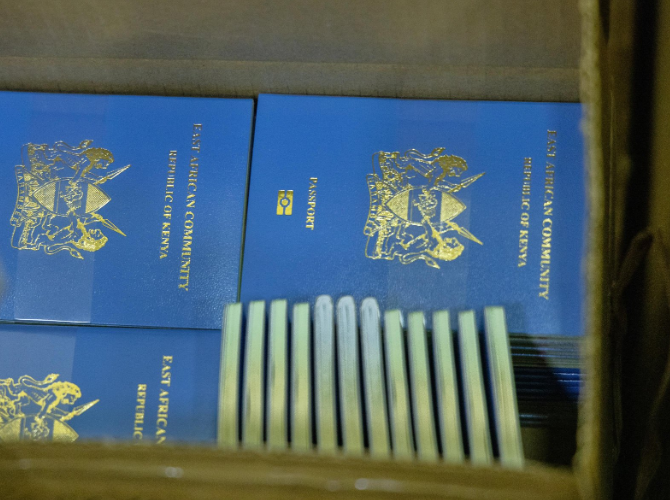
@KindikiKithure/X
According to Washington, the move is driven largely by economic and security concerns.
“President Trump has made clear that immigrants must be financially self-sufficient and not be a financial burden to Americans,” the State Department said in a statement.
“The Department of State is undergoing a full review of all policies, regulations, and guidance to ensure that immigrants from these high-risk countries do not utilise welfare in the United States or become a public charge.”
Kenya’s exclusion from the list points to a broader calculation beyond migration numbers. Nairobi’s long-standing cooperation with Washington on security, trade, and regional stability has worked in its favour at a time when the White House is prioritising national interest above all else.
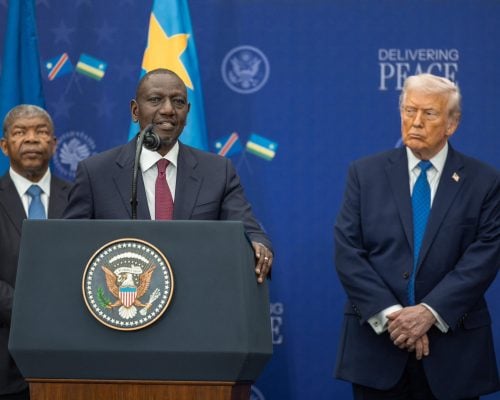
Security
The US maintains one of its largest diplomatic missions in Africa in Nairobi, reinforcing Kenya’s importance in American foreign policy on the continent. The country is also a key ally in counterterrorism efforts in the Horn of Africa, particularly through its military role in Somalia.
Kenyan forces have for years been central to the African Union Mission in Somalia, working alongside international partners to combat extremist groups such as al-Shabaab and ISIS.
From Washington’s perspective, this cooperation directly aligns with Trump’s security-first agenda. In a statement issued late last year, he underscored the need for tougher scrutiny in immigration decisions.
“The United States must exercise extreme vigilance during the visa-issuance and immigration processes to identify, before their admission or entry into the United States, foreign nationals who intend to harm Americans or our national interests,” Trump said on December 16, 2025.
“The United States Government must ensure that admitted aliens do not intend to threaten its citizens; undermine or destabilise its culture, government, institutions, or founding principles; or advocate for, aid, or support designated foreign terrorists or other threats to our national security.”
Trade and investment
Beyond security, Kenya’s economic profile has also played a role. As one of sub-Saharan Africa’s largest economies, Kenya is viewed as a gateway to East Africa and a vital trading partner, hence the estension of the Africa Growth and Opportunity Act (AGOA) deal
American companies have significant investments in the country, spanning technology, manufacturing, agriculture, and renewable energy.
These ties have been reinforced through trade frameworks and diplomatic engagement aimed at boosting regional growth.
The visa pause, which takes effect on January 21, 2026, applies strictly to immigrant visas. Even for affected countries, applicants will still be allowed to submit forms and attend interviews, though no immigrant visas will be issued during the review period.
Moreover, the State Department has described the measure as temporary, pending a comprehensive assessment of risk and compliance with US immigration standards.
President Trump, who returned to the White House in January 2025, has revived a hardline immigration stance, promising what he calls historic deportation operations and stricter controls at every entry point.
Yet Kenya’s omission from the suspension list suggests that countries seen as reliable partners, both economically and militarily, are being treated differently.