The questions ODM can no longer ignore
By Faith Lagat, December 7, 2025In the wake of Raila Odinga’s passing in October 2025, the Orange Democratic Movement (ODM) stands at a precarious crossroads.
Once Kenya’s unassailable bastion of opposition politics, forged in the fires of the 2005 constitutional referendum and tempered through decades of electoral battles, ODM now grapples with an identity crisis that threatens to erode its foundational ethos of social justice, inclusivity, and grassroots empowerment.
The party’s recent by-election triumphs in November, sweeping seats in Kasipul, Ugunja and beyond, offer a fleeting glimmer of resilience, yet they mask deeper fissures.
ODM is, however, not as a sinking ship, but as a vessel adrift, demanding urgent course correction to reclaim its moral and electoral stature.
These questions are not accusations but imperatives, pressing inquiries that, if addressed head-on, could restore ODM’s image as the people’s vanguard rather than a fragmented alliance of convenience.
Revolutionary roots vs governance deals
A central question emerges: how does ODM reconcile its revolutionary roots with the perceived compromises of the broad-based government? Raila’s handshake with President Ruto in March 2024 birthed a 10-point agenda aimed at stabilising the nation amid economic turmoil and electoral distrust.
By late 2025, roughly half of these reforms on electoral justice, economic equity, and institutional reforms have seen partial implementation, according to National Assembly Minority Leader Junet Mohamed.
Yet the pact has bred resentment. Siaya Governor James Orengo, a party elder and Youth League patron, warns that ODM risks “dying like other liberation movements in Africa” if it forsakes street activism for cabinet seats. The controversial death of blogger Albert Ojwang’ in police custody earlier this year reignited calls for ODM to “go back to the streets,” echoing the Gen Z protests of 2024.
ODM must confront this duality: is it a partner in governance extracting tangible wins such as debt relief for hustlers or police reforms, or a co-opted shadow of its former self? Ignoring this erodes trust among youth and urban voters who propelled ODM’s 2022 surge.
The party should convene a national convention by mid-2026 to transparently audit the agenda’s deliverables and publicly recommit to accountability.
Leadership vacuum
Another defining question is who truly leads ODM in this post-Raila era, and how leadership transitions will preserve internal democracy.
The vacuum left by Odinga’s death has amplified generational and regional tensions. The party leader, Oburu Oginga faced a State House snub in early December 2025, attending a high-level event alone amid whispers of exclusion by party heavyweights.
Winnie Odinga stunned the ODM@20 anniversary in November by questioning the “capacity” of current managers to handle UDA relations, urging a fresh mandate from members.
Life members led by Rachael Tabitha Machoka petitioned for Oburu’s resignation, citing constitutional breaches in sidelining loyalists. “It is deeply inappropriate for some leaders to speak with pride and boldly declare that they are legitimately in office, while the party constitution, particularly Article 6.2.2(b), has been blatantly violated,” the petition read.
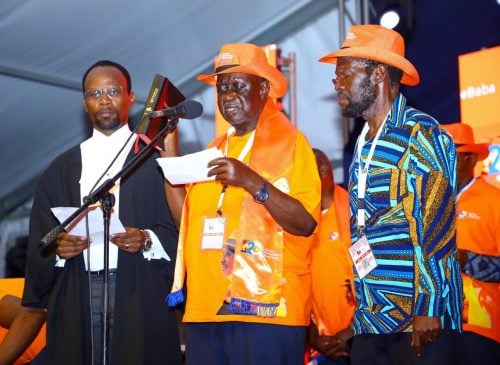
She also issued an open letter demanding immediate clarification from party chairperson Gladys Wanga and Junet Mohamed over allegations that ODM is being secretly “sold” through unauthorised political and financial deals.
Citing potential violations of the ODM Constitution, Machoka accuses the two of operating without transparency, warns that their silence fuels mistrust at a sensitive time for the party, and gives them a seven-day ultimatum to publicly confirm or deny involvement in any clandestine negotiations. She insists that ODM is not personal property, calls for accountability, and warns that failure to respond will compel her to demand their resignation.
Meanwhile, Nandi Senator Samson Cherargei branded Secretary General Edwin Sifuna a “mole” for the united opposition.
These rifts, visible in Western Kenya’s nomination chaos, signal a scramble for control. ODM’s image as a democratic beacon dims when processes appear opaque or kin-centric. The party must enforce Article 6.2.2(b) of its constitution by holding elections for party leader and deputies at the next National Delegates Conference, ideally in the first quarter of 2026.
2027 strategy
ODM must also determine whether it can purge internal saboteurs without fracturing its coalition architecture. Post-by-election purges loom, with ODM and UDA eyeing removal of MPs accused of disloyalty from key parliamentary posts.
Saboti MP Caleb Amisi has threatened to exit if the party remains in the “brutal Ruto regime” beyond March 2026, while fringe parties court disgruntled members.
Yet ODM’s strength has long been its big-tent appeal. To rebuild discipline, the party should establish an independent ethics board to investigate disloyalty claims fairly and to offer structured reconciliation.
The party must also articulate a coherent 2027 vision. Will it field a presidential candidate, as Sifuna insists, or seek a coalition arrangement, as some leaders hint? Without clarity, such as grooming a successor, the party risks irrelevance.

By mid-2026, ODM should unveil an “ODM Reborn” manifesto emphasising youth inclusion, anti-corruption commitments, climate justice, and rejection of tribal gatekeeping.
Healing regional wounds is equally critical. Western Kenya’s factionalism risks ceding ground to upstart parties, while Mt. Kenya dynamics may block future alliances. ODM must invest in branch revitalisation, secret ballots in internal elections, and mentorship programs to broaden appeal.
ODM’s story is not one of decline but reinvention. Raila’s legacy was building bridges amid storms; his successors must cross them without burning ends. By addressing these questions with transparency and resolve, ODM can emerge not just intact but invigorated, a party that inspires rather than endures.