Advertisement
Political engagement by govt officials: What Constitution says and why it matters
Tuesday 03rd March, 2026 07:06 AM|

The Constitution in Kenya clearly defines the border between the public service and partisan politics. During their tenure in office, state and public officers are supposed to respect all citizens irrespective of the active political rivalry that may involve them.
Nevertheless, with the country slowly turning its attention to the 2027 general election, there are clear indications of government officials who seem to be openly indulging in politics or are positioning themselves for an elective position in the government, yet they are still in power.
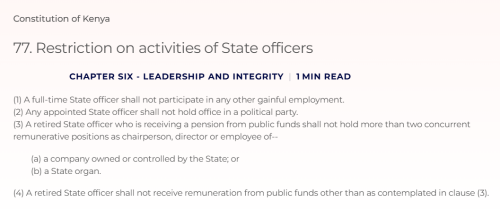
The Constitution of Kenya establishes strict limitations on the political involvement of the state officers. Article 77(2) states that a political party should not have an appointed state officer. State officers include Cabinet Secretaries, County Executive Committee Members (CECs), and other appointed persons.
“Any appointed state officer shall not hold office in a political party.” Article 77(2) states.
You Might Also Like



Besides this, the law of elections states that public officers who are planning to contest the elective office must resign within a given period before the election to avoid bias and misuse of the resources of the government during the campaigns.
Cabinet Secretaries engaged in active politics
In spite of these, there have been clear elements of partisan politics by a number of the Cabinet Secretaries. An example is the open defence of the political mobilisation by the Energy and Petroleum Cabinet Secretary Opiyo Wandayi, who has stated that his interest in the political discourse does not necessarily translate to office in the party.
“My participation in political discourse and mobilisation does not in any way translate to a pursuit of any party office,” Wandayi stated.

The same case applies to Treasury Cabinet Secretary John Mbadi, Mining Cabinet Secretary Hassan Joho and Public Service Cabinet Secretary Geoffrey Ruku, who have been caught at one time or another at a political meeting, rally or strategy meeting with party interests.
Government officials at the county level
Some County Executive Committee Members (CECs) and Chief Officers in various counties have been reported to have had an interest in challenging parliamentary, gubernatorial or ward representative seats.
The same constitutional principles of political neutrality also apply to the chief administrators in the county governments, county secretaries. When they start to run active campaigns or announce their political desires, they are supposed to step down from office in accordance with the electoral laws.
Anything less will result in a conflict of interest, misappropriation of government resources, and breach of constitutional norms. These restrictions are based on the need to uphold fairness in the political field. The officers are the wielders of state power and possess the public resources.
By letting them campaign in office, it will be like giving them an upper hand over other aspirants and compromising service provision. The provisions of the Constitution on leadership and integrity were densely crafted in order to avoid such cases by segregating governance and political rivalry.
With the political temperatures starting to increase before the next election cycle, the application of these constitutional provisions will be very important. The observation of Article 77 and other laws about elections is not a technical aspect of the law, and it is at the core of maintaining the integrity of the Kenyan public service and making the democratic contest fair, transparent and credible.
Author
Latest News








Advertisement
More on Insights