Inside the Ksh422B TSC allocation for teachers’ promotions and interns’ employment
By Ndiritu Wanjiru, May 28, 2026The Teachers Service Commission (TSC) has been allocated Ksh422 billion in the 2026/27 financial year, while the funding is to be used for teacher promotions, employment conditions and competency education trainings, as well as implementing a new agreement on salaries.
The information came out as part of deliberations before a parliamentary committee on the budget for the education sector on Wednesday, May 27, 2026, which reveals that the government continues to invest in the teaching profession despite the pressure to upgrade welfare and improve learning standards.
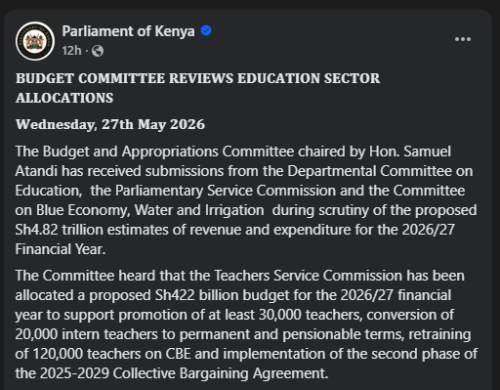
“The Committee heard that the Teachers Service Commission has been allocated a proposed Sh422 billion budget for the 2026/27 financial year to support the promotion of at least 30,000 teachers, conversion of 20,000 intern teachers to permanent and pensionable terms, retraining of 120,000 teachers on CBE and implementation of the second phase of the 2025-2029 Collective Bargaining Agreement,” Parliament noted in a statement.
Promotion of 30K
Part of the allocation will go towards promoting at least 30,000 teachers across the country. Teachers have long complained of job groups that have failed to grow and have been filled with teachers for long periods of time, with no career development opportunities.
The intended promotions would help clear the backlog and improve the morale of teachers in the primary, secondary and tertiary learning institutions under TSC. The transfer is also likely to minimise the conflict between teachers and the employer over delayed promotions and career advancement opportunities.
20K interns’ incorporation into P&P
The budget also aims to pave the way for 20,000 intern teachers to become permanent and pensionable.
Thousands of teachers working under internship agreements have asked for confirmation to become full-time. The internship programme has been repeatedly requested by thousands of teachers to confirm them as full-time teachers, although they are expected to have the same workload as full-time teachers, with lower pay and benefits.
The transition to permanent contracts, if successful, will give the impacted teachers employment security, pension benefits and better compensation.
The strategy is anticipated to help resolve the problem of teacher shortage in public schools and help reduce the volatility of the teacher supply in schools around the country.
Training teachers on Competency-Based Education
The other significant portion of the budget is for the retraining of 120,000 teachers for the competency-based education (CBE) curriculum.
The implementation of the new education system that has been adopted by the government, superseding the 8-4-4 system and focusing on skills, competencies of the learners and continuous assessment, has continued.
The application of the curriculum, however, has been criticised due to inadequate teachers, lack of learning materials and infrastructure problems.
The retraining programme is therefore expected to enable teachers to adequately cope with the changing curriculum and the mode of evaluation of the curriculum.
CBA implementation
PHOTO/Benard Orwong
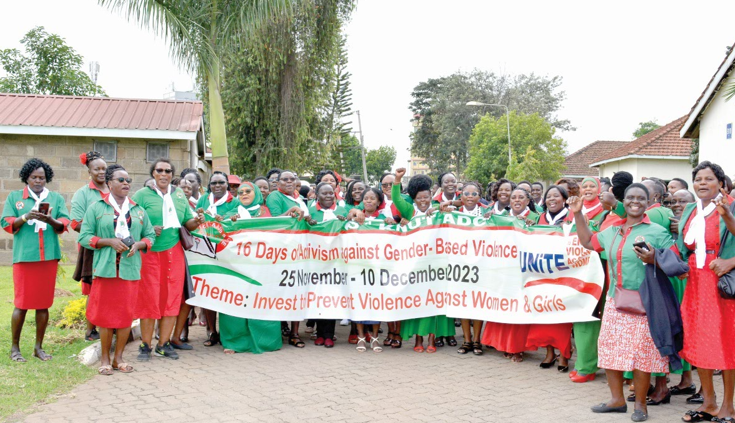
The proposed funding will also help put the second phase of the Collective Bargaining Agreement (CBA) for 2025-2029 into action. The agreement between TSC and teachers’ unions stipulates salary increases, allowances and better working conditions for teachers for five years.
Educational spending pressure.
The allocation of Ksh422 billion in the national budget reflects the continued importance of education in Kenya’s budget.
The funding plan has been put forward at the same time; however, the government has competing demands from other sectors, such as health, infrastructure, and security. Further scrutiny of the allocation is to be done by parliamentary committees before final approval of the national budget for the 2026/27 financial year.
Why the Ksh422B TSC allocation may fall short
Despite the allocation, the funding may still be inadequate given persistent teacher shortages, stalled promotions and challenges facing CBE implementation.
Out of the current 44,000 intern teachers, about 24,000 will remain without permanent and pensionable employment despite continued staffing gaps in schools.
Stakeholders have also raised concerns over transparency and accountability in recruitment and promotion processes, calling for increased funding and strict oversight to ensure the allocation directly benefits teachers and learners.