Advertisement
Incorporate climate education in curriculum
Wednesday 07th September, 2022 05:26 AM|
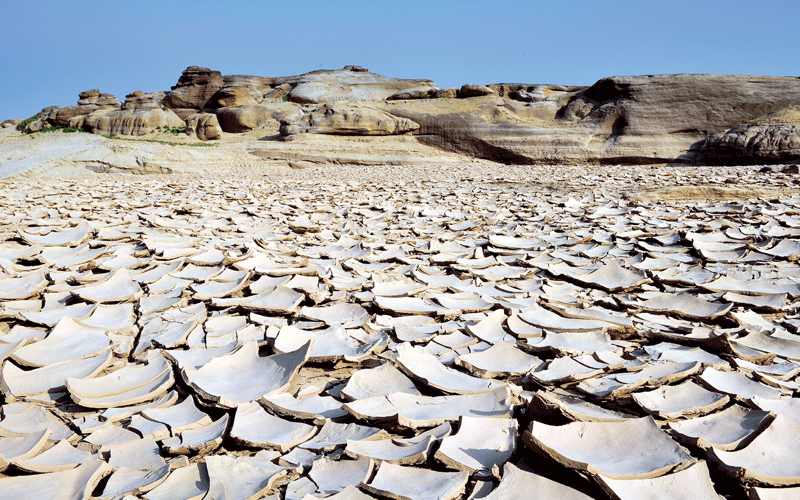
In recent times, millions of people globally have united in a call for urgent action on the restoration of the planet after decades of rampant degradation. This rallying call to restore the planet’s ecosystems is not one that can be ignored, now more than ever. As we adjust the new normal, we are re-learning a critical lesson: we do not exist separately from nature but as an interconnected system.
It is clear that if human activities such as pollution, deforestation and exploitation of natural resources go on, we will continue to grapple with consequences of an unhealthy planet. This includes global warming and climate change that continue to cause extreme weather events such as floods, hurricanes, droughts and famines.
Therefore, the call to take urgent action to restore the earth is not one to be taken lightly, and we must all take responsibility for the impact our actions have on the environment. Consumers, for example, can recycle and re-use products, participate in activities such as waste-collection and tree planting. Manufacturers, likewise, need to embrace sustainable technologies such as eco-design, resource efficiency and sound waste management.
Nevertheless, we must recognize that an essential element for the success of any of these actions is education. To enable both citizens and institutions to become environmental stewards, there is a dire need to empower them with the necessary information. Indeed, a study conducted in China in 2011 found that education plays a key role in improving people’s environmental knowledge and promoting realisation of their responsibility for the environment.
Climate education helps people understand and address the impacts of global warming, encourages behavior change and increases their adaptation and mitigation capacity to environmental issues. In Nairobi for example, a youth group in Dandora is restoring former dumping sites into green spaces and teaching community members on the importance of environmental restoration which has in turn led to positive behavior change.
According to experts, climate and environmental education will help raise a new generation of individuals equipped with the ability to make better sustainable consumer choices. It will lead to job creation, boost the economy, increase innovation and the creation of environmentally friendly products.
Plastiki Rafiki, for example, a student-led club at the International School of Kenya is recycling discarded plastic to make innovative products and empower local communities to earn a living. This demonstrates the need to accord climate and environmental education the same importance as any core subject like mathematics or science.
Kenya, sadly, is characterised by relatively low awareness levels and an education system that places little emphasis on environmental education, a subject that is presently a privilege for students in select schools. This in turn breeds adults who have little appreciation for the benefits the natural environment offers.
At the Kenya Extended Producer Responsibility Organization (KEPRO), we believe that it is crucial to empower every Kenyan with the right education to successfully restore our environment. Our goal, therefore, is to drive public awareness in Kenya on conservation, sustainable waste management practices, recycling, and the circular economy. Given both the ever-increasing risks and numerous opportunities to create a better environment for current and future generations, building a climate-literate population is key.
We call upon the government to incorporate climate education as a core subject in our school curriculum to ensure that every child is educated on the climate crisis and organizations to prioritize climate education in their sustainability agenda. We must all act together to prepare learners and all members of societies for the challenges climate change poses and equip them with the knowledge and competencies needed to act as informed citizens in the restoration of our planet.
— The writer is a Board Member of Kenya Producer Responsibility Organisation and can be reached at [email protected].
Author
PD columnist
View all posts by PD columnistLatest News








Advertisement
More on Insights