Ignored warnings: How Kenya’s femicide crisis exposes failures in protection systems
By Lavender Kusimba, May 21, 2026When women are killed in Kenya, the warning signs are often already there. Friends know. Families know. Neighbours know. Sometimes even authorities know. Yet in many cases, nothing happens until another woman’s death becomes a headline.
A joint statement released by women’s rights organisations, legal groups and social justice movements this week paints a grim picture of a country where violence against women is no longer viewed as an isolated tragedy but as a systemic national crisis fuelled by institutional failure, silence and weak protection systems.
“We cannot stand by and watch as women and girls continue to suffer such violence,” the organisations said in the statement. “Femicide and violence against women and girls in Kenya have reached crisis levels and require immediate national intervention.”
The statement was signed by multiple organisations, including FIDA-Kenya, the Law Society of Kenya, the Kenya Human Rights Commission, Child Space Organisation and other gender justice groups.
But beyond the outrage lies a disturbing pattern: many victims had already reported abuse before they were killed.
“The data shows that most perpetrators are intimate partners or family members, and many cases happen at home,” the statement noted. “In most cases, victims had already reported abuse, shared their fears, or asked for help from family, police, or community leaders, but were ignored or sent to other dispute resolution methods.”
That single observation may explain why Kenya’s femicide crisis continues to deepen despite growing public awareness campaigns.
According to the organisations, FIDA-Kenya alone recorded 70 weekly cases in 2026 across its three offices, with half directly linked to physical and sexual violence by intimate partners.
Reports cited from Amnesty International Kenya indicate that at least eight femicide cases are reported every week nationally, meaning nearly one woman or girl is killed every day in Kenya.
Women aged between 18 and 35 account for 59 per cent of all reported femicide cases, with many victims being university and college students.
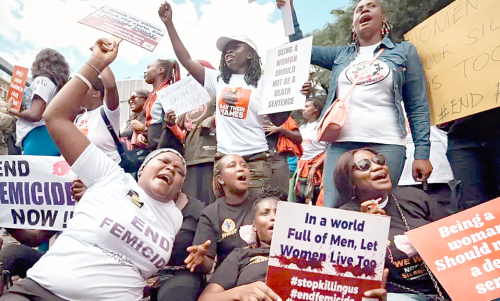
Inside Kenya’s femicide crisis
The deaths highlighted in the statement reveal how violence increasingly follows women into spaces once considered safe homes, campuses and relationships.
In April 2025, first-year Multimedia University student Sylvia Kemunto was found dead in a water tank. That same month, 21-year-old Rose Benter Apondi, a student at Ramogi Institute of Advanced Technology, was murdered. Another victim, Anita, was stabbed to death.
In May this year, gospel musician Rachel Wandeto died after she was attacked, doused with petrol and set on fire by unknown assailants. For activists, the brutality of these killings reflects a dangerous normalisation of violence against women.
“We are deeply troubled by the daily reports of women being killed in horrific ways,” the organisations said. “Some have been assaulted and murdered, some attacked with corrosive chemicals, others dismembered, and their bodies discarded without dignity.”
Yet analysts argue the deeper crisis lies not only in the violence itself but also in Kenya’s repeated failure to intervene early.
Many abuse cases are still handled informally through family negotiations, local mediation, or pressure for reconciliation, even when victims fear for their lives.
In some communities, domestic violence is still treated as a private matter rather than a criminal offence requiring urgent state intervention.
Women’s rights groups say that approach has created a culture where threats and abuse are minimised until they escalate into murder. The crisis is also exposing the gaps between legislation and implementation.
Protection
Kenya has several laws meant to protect women, including the Protection Against Domestic Violence Act and constitutional guarantees on equality and security. But survivors often struggle to access protection orders, police support, shelters and legal assistance.
For many young women, especially students and economically dependent partners, leaving abusive relationships can be financially and socially difficult.
Activists warn that economic stress, unemployment, online harassment and toxic masculinity are also intensifying violence against women, particularly among younger populations.
The organisations behind the statement now want the government to treat femicide as a national security and public health emergency rather than isolated criminal incidents.
Their demands include faster investigations, stronger survivor protection systems, specialised gender desks in police stations and better accountability for law enforcement officers accused of ignoring reports of abuse.
But perhaps the strongest message from the statement is that Kenya’s femicide crisis is no longer simply about individual perpetrators.
It is about institutions that fail to act, communities that normalise warning signs and systems that repeatedly abandon women asking for help.
“We stand together with the victims of femicide and their families, as well as all survivors of violence against women and girls in Kenya,” the organisations said.
As public anger grows over the increasing killings, Kenya now faces difficult questions about whether enough is being done to stop violence before it turns fatal. Behind nearly every femicide case is often a woman who has already tried to survive.