Explainer: How NTSA’s KRA PIN for vehicle e-logbook registration will work
By Aloys Michael, May 16, 2026The National Transport and Safety Authority (NTSA) has clarified that a valid Kenya Revenue Authority (KRA) PIN will remain mandatory for all vehicle ownership transactions under the new digital e-logbook system set to roll out next month.
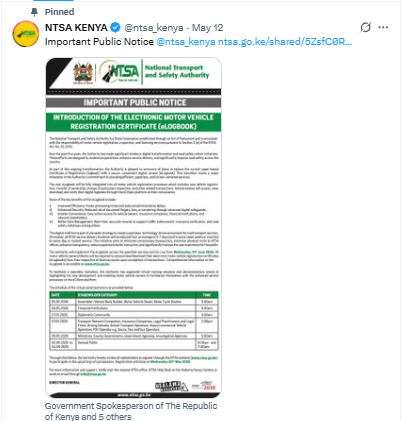
NTSA plans to fully replace physical vehicle logbooks with digital e-logbooks starting June 10, 2026, as part of efforts to modernise vehicle registration and curb fraud in the sector.
The shift marks a transition from the current paper-based registry to a real-time digital platform designed to reduce delays, eliminate forged logbooks, and improve the accuracy of ownership records.
Questions had emerged among motorists over whether the new system would allow vehicle registration and ownership transfers without a KRA PIN.
However, NTSA has maintained that the requirement will remain unchanged.
According to the Authority, every person involved in a vehicle ownership transaction must still possess a valid KRA PIN for the process to proceed.
Under the new framework, vehicle owners will also be able to register vehicles under joint ownership, allowing more than one individual to appear as owners on the same e-logbook.
NTSA explained that vehicle transfers will begin with the seller initiating the process through the NTSA system. The buyer will then receive the request and approve the transfer through their eCitizen account.
Where a digital logbook is available, users will be required to download and upload the e-logbook during the transfer process.

In cases where the vehicle has not yet migrated to the digital platform, users may still attach a physical logbook.
Prospective buyers seeking to confirm ownership details before purchasing a vehicle will also be required to apply for a motor vehicle copy of records through the services section on their NTSA accounts.
The Authority says the new system is expected to improve transparency in the motor vehicle sector, which has long faced challenges such as duplicate ownership records, fake logbooks, and slow processing timelines.
The clarification comes as the number of registered vehicles in Kenya surpasses six million, while the number of licensed drivers has risen to more than 5.6 million, according to NTSA data.
Ahead of the rollout, NTSA has launched a 10-day virtual sensitisation campaign to educate motorists and stakeholders on how the e-logbook system will work.
Vehicle owners have been urged to register for the online sessions through the authority’s website before May 20, 2026.