Willis Otieno pins Kenya’s crisis on mismanagement
By Faith Lagat, April 4, 2026Renowned constitutional lawyer and Safina Party Deputy Leader Willis Evans Otieno has sparked renewed debate on Kenya’s economic situation, arguing that the country’s struggles stem from mismanagement rather than inherent poverty.
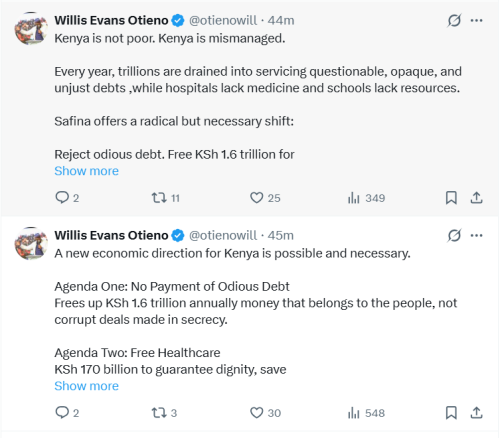
In an X post dated April 4, 2026, Otieno stated: “Kenya is not poor. Kenya is mismanaged. Every year, trillions are drained into servicing questionable, opaque, and unjust debts, while hospitals lack medicine and schools lack resources.”
Controller of Budget Margaret Nyakang’o has warned Parliament of a “vicious cycle of debt accumulation,” where costly borrowing and poor project coordination erode fiscal space.
Interest payments alone reached Ksh 464.49 billion, with over half of repayments covering financial costs rather than reducing principal. Projections for FY 2025/26 suggest debt servicing could exceed Ksh 1 trillion, limiting funds for healthcare, education, and development.
“Half of debt payments are only financial costs rather than debt reduction. The principal figure is not reducing; we are just paying interest,” Nyakang’o said, adding that interest payments alone now stand at Ksh464.49 billion, accounting for 54 per cent of total debt service.
Debt burden and public spending
Otieno’s critique mirrors broader concerns over the mismatch between ambitious budget proposals and actual revenue collection. Successive governments have pursued major infrastructure and recurrent spending projects, yet revenue shortfalls have increased reliance on domestic and external borrowing.
A significant portion of debt now finances recurrent expenditure, including salaries and interest, rather than generating productive assets or long-term growth.
Economic capture and inequality
Otieno highlighted economic capture by a powerful few, where wealth flows upward while farmers, hustlers, teachers, and youth struggle.
He calls for citizen-centred leadership to address unemployment, high living costs, and failing public services. Safina proposes a radical shift through its FIST agenda: reject odious debt, guarantee free healthcare and education, reduce the sales tax to 5 percent, and end domestic borrowing.
“Our focus must remain firmly on the people and the economy, not on backroom negotiations where legacy politicians bargain over positions and power ahead of the election,” Otieno wrote.