Advertisement
Willis Otieno: Kenya’s policing system still carries scars of colonial control
Thursday 06th November, 2025 07:34 AM|

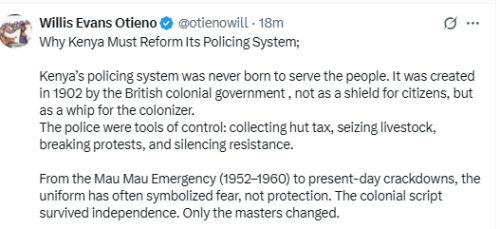
Lawyer and political analyst Willis Otieno has called for deep reforms within Kenya’s policing system, arguing that its foundation was never meant to serve the people but to suppress them, a legacy that still lingers more than 60 years after independence.
In a post shared on X on Thursday, November 6, 2025, Otieno traced the roots of Kenya’s police system to colonial times, saying it was designed by the British administration to instil fear and control rather than provide public safety.
“Kenya’s policing system was never born to serve the people, it was created in 1902 by the British colonial government, not as a shield for citizens, but as a whip for the coloniser,” Otieno wrote.

He noted that the original role of the police under British rule was not to protect Kenyans, but to enforce the will of the colonial state through intimidation and violence. “The police were tools of control: collecting hut tax, seizing livestock, breaking protests, and silencing resistance,” he said.
You Might Also Like



Otieno highlighted that the same oppressive systems and attitudes have continued even after independence. According to him, the police force inherited the colonial structure and culture of fear instead of transforming into a service-oriented institution.
“From the Mau Mau Emergency (1952–1960) to present-day crackdowns, the uniform has often symbolised fear, not protection. The colonial script survived independence. Only the masters changed,” he added.
His remarks come amid growing public frustration over alleged cases of police brutality, extra-judicial killings, and the use of excessive force during protests. Many Kenyans have long argued that the policing culture remains punitive and militarised, often prioritising control over service.
Otieno’s post has sparked wide discussion online, with many echoing his view that Kenya’s policing system needs a complete cultural and structural transformation to reflect a people-centred approach.
His message adds to the ongoing national debate about accountability and reform within the National Police Service, a call that continues to resonate across generations seeking justice, dignity, and true protection from those entrusted to provide it.
Author
Latest News






Advertisement
More on Inside Politics