Willis Otieno: Kenya Kwanza’s bottom-up promise is becoming a burden for citizens
By Ndiritu Wanjiru, April 13, 2026Constitutional lawyer and Safina Party deputy leader, Willis Otieno, has criticised the direction of governance under President William Ruto, saying that an increasing disparity between political pledges and experienced realities is rapidly becoming a hallmark of the present government.
Taking it to his X handle on Sunday, April 12, 2026, Otieno has explained an increasing mismatch between the bottom-up economic transformation agenda championed by the Kenya Kwanza coalition and the real-life experiences of ordinary Kenyans.
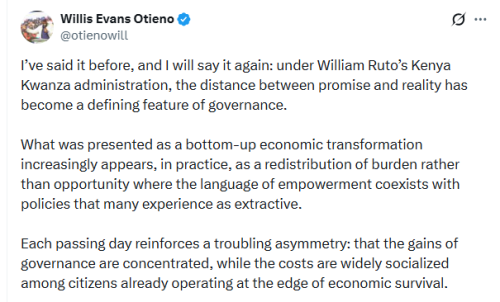
“I’ve said it before, and I will say it again: under William Ruto’s Kenya Kwanza administration, the distance between promise and reality has become a defining feature of governance.
“What was presented as a bottom-up economic transformation increasingly appears, in practice, as a redistribution of burden rather than opportunity, where the language of empowerment coexists with policies that many experience as extractive,” Otieno stated.
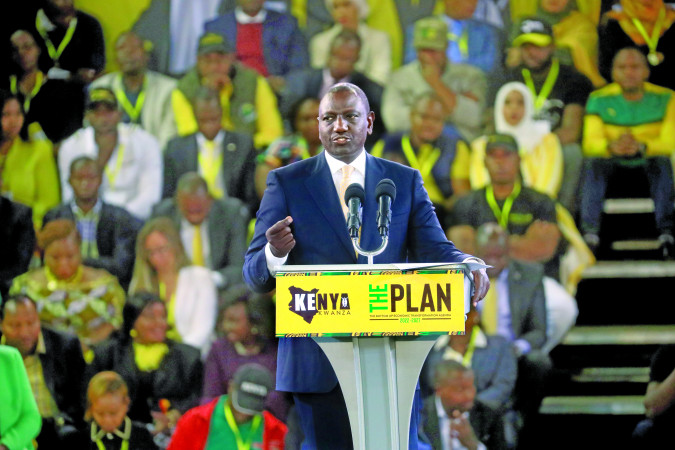
Despite the administration’s campaign of financial empowerment for the marginalised, critics like Otieno contend that its policy execution conveys a different message – one of financial pressure on individuals rather than the creation of more opportunities.
Otieno believes that the rhetoric of empowerment remains dominant in official communication, yet in practice, Kenyans are struggling with extractive policies as perceived by many. Increasing taxation, pressure on the cost of living, and fiscal changes have, in his opinion, burdened the economic adjustment for the citizens who are already struggling to make ends meet.
Governance imbalance
He also points out what he calls a worrying imbalance in the results of governance. The gains of state policy in this framing are seen as concentrated in the hands of a few, with the rest of the population as the losers. He says that this imbalance compromises the trust of the masses and calls into question the inclusivity of the existing economic paradigm.
“Each passing day reinforces a troubling asymmetry: that the gains of governance are concentrated, while the costs are widely socialised among citizens already operating on the edge of economic survival,” Otieno added.
The criticism contributes to an increasingly national discussion of the effectiveness and fairness of the Kenya Kwanza agenda. With ongoing economic difficulties, opinions like Otieno’s will likely continue to influence public debate, as they demand a higher level of accountability and a reality that matches policy promises against the experiences of millions of Kenyans.