Advertisement
Willis Otieno blames policy failures as pump prices jump to Ksh206
Wednesday 15th April, 2026 06:54 AM|

The sudden rise in diesel prices has started a new discussion about Kenya’s economy. Willis Otieno, a constitutional lawyer and the deputy leader of the Safina Party, said that the move was a direct result of bad policy choices made by the current government.
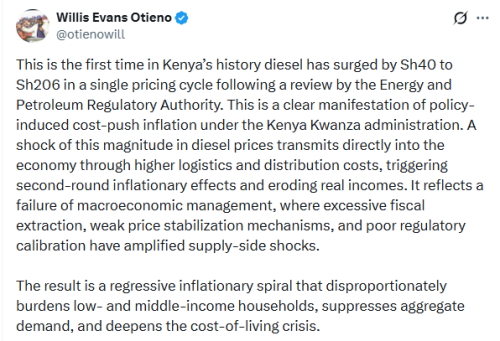
Going to X on Wednesday, April 15, 2026, Otieno indicated a sudden increase in fuel prices, which he termed unheard of—soaring by Ksh40 to retail at Ksh206 in one pricing cycle, according to a review by the Energy and Petroleum Regulatory Authority (EPRA). According to him, this radical change is not just a market fluctuation but an indication of structural and policy-based vulnerabilities within the economy.
“This is the first time in Kenya’s history that diesel has surged by Ksh40 to Ksh206 in a single pricing cycle, following a review by the Energy and Petroleum Regulatory Authority. This surge is a clear manifestation of policy-induced cost-push inflation under the Kenya Kwanza administration,” Otieno stated.
Otieno contends that this growth exemplifies cost-push inflation, where the economy passes on the rising input costs, particularly fuel. Diesel, which is used in transport, manufacturing, and agriculture, has been a key element in dictating the price of goods and services. With the increase in prices, the businesses will definitely transfer the new costs to the consumers.
You Might Also Like



This scenario is pure evidence of cost-push inflation instigated by policies, and, as Otieno remarked, the shock is already spreading through major industries because it is increasing the costs of logistics and distribution. He cautioned that the second-round inflationary pressures are likely to exacerbate the cost of living.
He deplored what he described as “lost macroeconomic management,” citing overly fiscal extraction policies, ineffective price stabilisation policies, and ineffective regulatory calibration. To him, these have not only been ineffective at protecting Kenyans against global supply shocks but have actually enhanced their effect.
The lawyer also cautioned that low and middle-income households disproportionately bear the brunt of such fuel price shocks. Transport and commodity prices are rising, and real incomes are decreasing as a result, leaving most families unable to afford necessities.
Otieno described the entire situation as a regressive inflationary spiral, placing the burden of rising expenses on the most vulnerable. This, he opined, ultimately stifles aggregate demand, slows the economy, and worsens the current cost-of-living crisis.
New fuel prices
The statement from the lawyer came after the Energy and Petroleum Regulatory Authority (EPRA) on Tuesday, April 14, 2026, announced an increase in the maximum retail prices of petroleum products.
In a press release on Tuesday, April 14, 2026, EPRA said the new prices will be in force from April 15 to May 14, 2026.
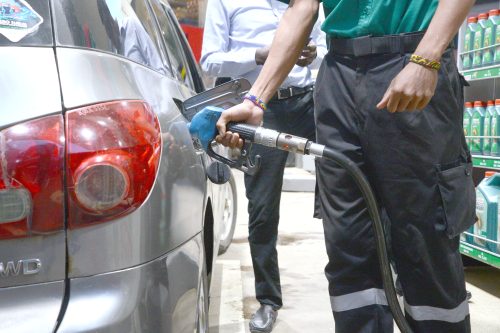
However, the price of kerosene remains unchanged during the review period.
Author
Latest News







Advertisement
More on Inside Politics