Willis Otieno accuses Ruto of prioritising campaigns over fixing schools, SHA
By Kiprono Keileb, February 3, 2026City lawyer and political commentator Willis Otieno has criticised President William Ruto for focusing on political campaigns instead of addressing pressing issues in education and healthcare.
In a statement shared on X on Tuesday, February 3, 2026, Otieno highlighted the strain on schools, the struggles of parents, and the state of public hospitals under the current administration.

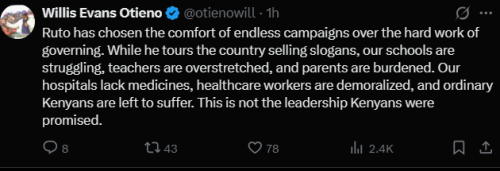
“Ruto has chosen the comfort of endless campaigns over the hard work of governing. While he tours the country selling slogans, our schools are struggling, teachers are overstretched, and parents are burdened. Our hospitals lack medicines, healthcare workers are demoralised, and ordinary Kenyans are left to suffer. This is not the leadership Kenyans were promised.” Willis Otieno
He also drew attention to the challenges faced by the National Health Insurance Fund (SHA), stating that the system was failing citizens when they needed it most. Otieno accused the government of prioritising image over service delivery, warning that Kenyans were paying the price for what he described as “political theatre.”
“The focus should be on solving problems in education and healthcare, not on photo opportunities and endless rallies. Citizens expect leadership that delivers services, not slogans,” he said.
He further noted that schools are facing shortages of essential resources, teachers are overworked, and students are suffering, while hospitals experience frequent medicine stockouts, and healthcare professionals are under pressure.
Otieno urged the President and his administration to take immediate steps to address these challenges, rather than engaging in continuous campaigns that distract from governance.
“Leadership is about making tough decisions and ensuring systems work. Campaigning is important, but it cannot replace the responsibility of the government to serve its people,” he added.
He concluded by appealing to government officials to prioritise the needs of ordinary citizens and strengthen key sectors to ensure that services reach those who rely on them the most.