Wetang’ula targets unregistered voters in Western Kenya, says region can deliver 5M votes
By Mustafa Juma, July 17, 2026National Assembly Speaker Moses Wetang’ula has intensified the push for voter registration in Western Kenya, urging church leaders to mobilise eligible residents ahead of the 2027 General Election while declaring that the region has the potential to deliver more than five million votes if fully organised.
Taking to his official X account on Friday, July 17, 2026, after the MUCODET and Mothers’ Union fundraising service at ACK Diocese of Mumias in Nangili, Matungu Constituency, Wetang’ula said hundreds of thousands of eligible residents in Kakamega and Bungoma counties were yet to register as voters despite already possessing national identity cards.
The Speaker challenged religious leaders, particularly members of the Anglican Church’s Mothers’ Union, to spearhead voter registration campaigns within their communities, arguing that democracy can only thrive when citizens actively participate in elections.
“I urged church leaders to encourage every eligible Kenyan with a national identity card to register as a voter because democracy is strongest when every citizen participates,” Wetang’ula stated.
According to the Speaker, nearly 400,000 eligible residents in Kakamega County and 346,000 in Bungoma County have national identity cards but have not registered as voters.
“Those who choose not to vote surrender their voice and allow others to determine their future,” he said.
5 million votes
Wetang’ula said Western Kenya, comprising Bungoma, Kakamega, Busia, Vihiga and Trans Nzoia counties, could collectively contribute more than five million votes if voter registration efforts are intensified.
“United in purpose and focused on our shared interests, our region can play an even greater role in shaping Kenya’s future,” he added.
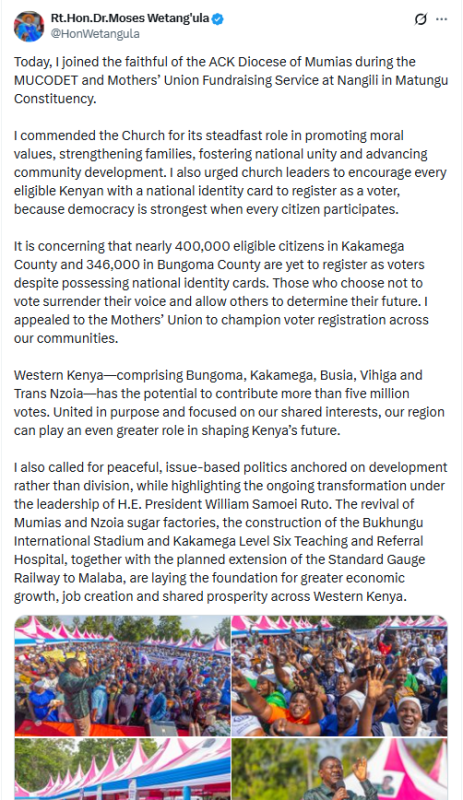
Voter registration campaign
The remarks come amid an aggressive voter registration campaign being championed by Kenya Kwanza leaders in Western Kenya ahead of the 2027 General Election.
In recent weeks, Wetang’ula has repeatedly argued that the region’s political bargaining power will ultimately depend on the number of registered voters rather than population alone.
The speaker also used the church service to urge political leaders to embrace peaceful, issue-based campaigns centred on development instead of ethnic divisions.
He said the Kenya Kwanza administration had laid the foundation for economic transformation in Western Kenya through several flagship projects, including the revival of Mumias Sugar Company and Nzoia Sugar Company, the construction of the Bukhungu International Stadium, the Kakamega Level Six Teaching and Referral Hospital, and the planned extension of the Standard Gauge Railway (SGR) to Malaba.
Wetang’ula argued that the projects would stimulate economic growth, create jobs and improve livelihoods across the region.
His latest appeal follows similar calls by President William Ruto, who recently challenged leaders from Western Kenya to ensure that every eligible resident with a national identity card registers as a voter, saying the region has approximately 1.5 million people who possess IDs but are yet to obtain voters’ cards.
The renewed mobilisation has become a central feature of Kenya Kwanza’s political strategy in Western Kenya as the coalition seeks to consolidate support ahead of the next General Election.
Political observers say voter registration is increasingly emerging as one of the most important battlegrounds ahead of 2027, with leaders across the political divide recognising that turnout and voter numbers could significantly influence coalition bargaining power and the outcome of the presidential race.
Wetang’ula has previously maintained that Western Kenya’s influence in national politics will depend on its ability to register more voters and turn out in large numbers during elections, arguing that a stronger voting bloc would enhance the region’s leverage in future political negotiations.