Wamalwa: Western is part of 75% of Kenyans who have lost faith in Ruto’s govt
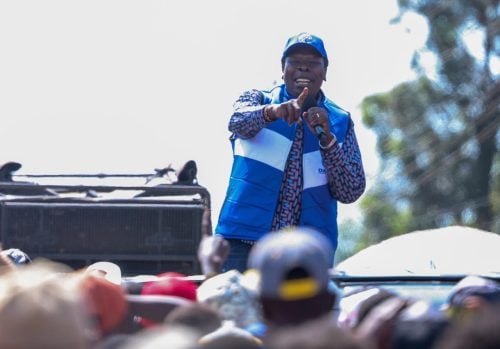
By Kenneth Mwenda, June 22, 2026Former Cabinet Secretary and DAP-K leader Eugene Wamalwa has said that Western Kenya is part of what he estimates as 75 percent of Kenyans who have lost trust in the government of President William Ruto.
Speaking during a television interview on Sunday, June 21, 2026, Wamalwa said the region is shifting politically due to what he called broken promises, stalled projects, and rising public frustration.
He, however, insisted that political competition should remain peaceful.
“We are not enemies. We are competitors,” he said. “They have the right to be where they are and to sell their policies, and we will compete. The people will decide.”
Wamalwa said his political style has always avoided hostility, adding that even in past political cycles, his family has treated opponents as rivals, not enemies.
‘A boulevard of broken promises’
Wamalwa said dissatisfaction in Western Kenya has grown sharply after what he described as unfulfilled pledges by the current administration.
“When you walk across Western, it is like a boulevard of broken promises,” he said.
He pointed to the sugar sector as a major example. He said the government promised quick reforms at Nzioa Sugar, including new milling equipment, payment of farmers and workers, and settlement of retirees within 100 days.
He claimed these commitments were not fulfilled.
Instead, he said, the government has overseen the sale of factories, including Mumias and Sony sugar companies, to private investors.
“There are two or three families that are now creating a monopoly in the sugar belt,” Wamalwa said.
He also said more than 5,000 workers lost jobs, leaving families in financial distress.
Wamalwa contrasted the current administration with the government of former President Uhuru Kenyatta, saying Western Kenya saw more visible development during that period.
He said sugar factories remained operational, and new industrial projects began, including a gold refinery project in Kakamega and a granite processing plant in Vihiga.
He also cited expansion in higher education, noting the establishment or upgrading of institutions such as Kibabii University, Kaimosi University, and Alupe University.
“These were transformative projects,” he said.
He added that water projects supported by international partners were implemented in Vihiga, Trans Nzoia, and Busia counties.
Wamalwa said many of those projects have either stalled or not reached completion under the current government.
He said this has deepened frustration among residents, especially young people facing unemployment.
“What people are seeing now is stagnation,” he said. “The region is asking hard questions about development.”
He argued that Western Kenya has not received its fair share of national development and urged residents to reconsider their political alignment.
Opposition unity and political strategy
Wamalwa said opposition leaders are working together to build a broad coalition ahead of the 2027 elections.
He said he is not interested in regional politics or ethnic titles.
“I want to be president. I do not want to be a Luhya kingpin,” he said.
He added that leaders such as the late Michael Kijana Wamalwa inspired a national outlook rather than a regional one.
Wamalwa also mentioned consultations with elders, including trade unionist Francis Atwoli, whom he described as part of the Luhya Council of Elders advisory network.
Wamalwa said the opposition is building unity across different political parties and leaders.
He welcomed collaboration with Nairobi Senator Edwin Sifuna, saying they are not competitors but partners.
“With Sifuna, we are not competing, we are complementing,” he said. “We are building a united opposition that will form the next government.”
He said opposition leaders expect to support whoever secures the presidential ticket.
“If it is not me, I will support whoever is picked,” he said.
Wamalwa also said consultations are ongoing with several leaders, including former Chief Justice David Maraga and former Cabinet Secretary Justin Muturi.
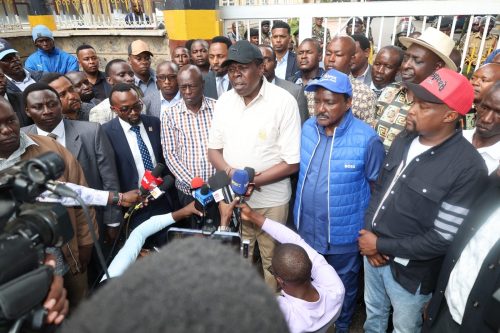
He said Jimi Wanjigi remains open to further discussions despite signalling interest in running independently.
Role of Kalonzo and broader coalition
Wamalwa highlighted close cooperation with Wiper leader Kalonzo Musyoka, saying their collaboration has strengthened over the past few years.
He recalled joint political engagements, including discussions with former Deputy President Rigathi Gachagua during moments of political tension.
He said the opposition formally welcomed Gachagua into their fold in January 2025 at a DAP-K event in Nairobi.
Other leaders, including Martha Karua and Justin Muturi, have also joined the broader opposition platform at different stages, he said.
Wamalwa said the opposition has built connections across regions, including Mount Kenya, the Coast, Kisii/Nyanza, and Eastern Kenya.
He said this reflects a growing national mood for political change.
“The leaders might not always be united, but the people are,” he said.
He added that the movement is driven by shared concerns over the economy, jobs, and government delivery.