Uhuru outperformed Ruto in first-term infrastructure projects – AI
By Faith Lagat, February 7, 2026For years, Kenyans have debated which administration delivered more tangible infrastructure within its first term: former President Uhuru Kenyatta (2013–2017) or President William Ruto (2022–present).
The discussion has played out across social media, public forums and political rallies, often shaped by partisan claims.
An independent Artificial Intelligence (AI) assessment undertaken by People Daily Digital now provides a structured comparison based on publicly documented records and project status as of early 2026.
We asked different AI chatbots the same question: ‘In your own unbiased assessment, of all the infrastructure projects done by retired president Uhuru Kenyatta in his first term and the projects done by President William Ruto up to now in his first term, which of the two [Uhuru and Ruto] has delivered more in terms of development?’
The answers indicated that Uhuru’s administration delivered more infrastructure projects in its first term than Ruto’s current regime.
“As of early 2026, Uhuru Kenyatta’s first term shows more completed, large-scale infrastructure projects delivered within that period itself, particularly in transport (roads and rail).
“In contrast, William Ruto’s term exhibits a large pipeline of major works, many of which are in progress and expected to be delivered later.”
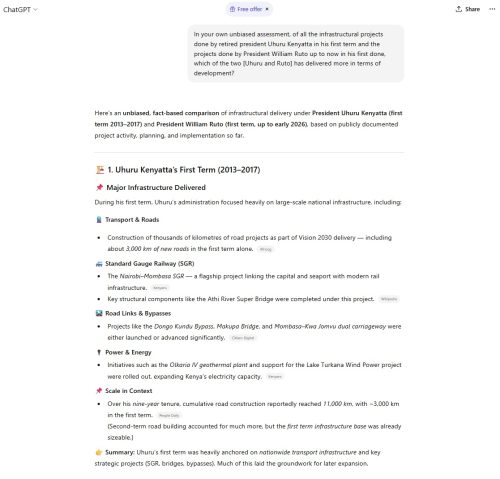
“In plain terms: Ruto has launched an ambitious set of projects, but most are still unfolding. Uhuru delivered finished mega-infrastructure projects within his first term.”
Scope and method of assessment
The AI review examined transport, energy, housing and urban development projects initiated and delivered within the first five years of each administration.
The assessment focused on projects that were completed and operational within the period, distinguishing them from those still under construction or at planning stages.
Data sources included government project reports, infrastructure agencies’ publications and publicly available commissioning records. The analysis did not assess policy reforms outside physical infrastructure.
Uhuru Kenyatta’s first-term delivery
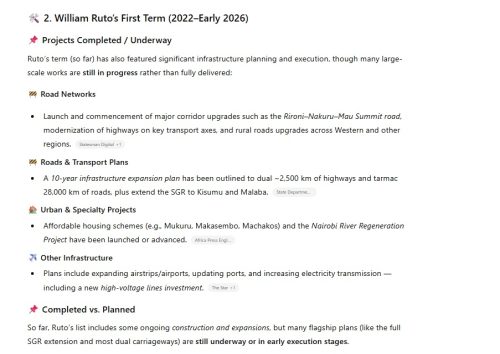
According to the assessment, Uhuru Kenyatta’s first term recorded a higher number of completed large-scale infrastructure projects, particularly in transport and energy.
Key among these was the Nairobi–Mombasa Standard Gauge Railway, which was completed and opened to the public within the term.
The review also notes the construction and completion of approximately 3,000 kilometres of new roads, alongside major bypasses and dual carriageways such as Dongo Kundu and the Mombasa–Kwa Jomvu corridor.
In the energy sector, projects including the Olkaria IV geothermal plant and the Lake Turkana Wind Power project were completed and connected to the national grid.
The assessment highlights that these projects were not only initiated but also commissioned, contributing directly to transport efficiency, power generation capacity and regional connectivity during the first term.
Ruto’s first-term pipeline
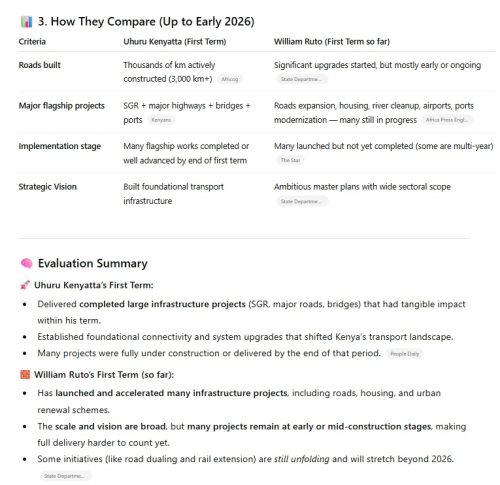
President William Ruto’s administration, in its comparable period, is assessed as having launched a broad pipeline of infrastructure initiatives across transport, housing and urban renewal.
These include upgrades along the Rironi–Nakuru–Mau Summit corridor, a long-term plan to dual 2,500 kilometres of highways and tarmac 28,000 kilometres of roads, affordable housing developments in areas such as Mukuru and Machakos, the Nairobi River regeneration programme, and proposed extensions of the Standard Gauge Railway towards Kisumu and Malaba.

However, the AI assessment notes that many of these projects are at construction or early implementation stages and are yet to be completed or commissioned.
As a result, when measured strictly by completed and operational infrastructure within the first term, the analysis finds that Uhuru Kenyatta’s administration recorded higher delivery.
The review also observes that the current administration’s agenda includes reforms and financing mechanisms that extend beyond physical infrastructure, which were not part of this specific comparison.