TIFA: Why broad-based govt has failed to lift public confidence
By Aloys Michael, June 4, 2026The political truce between President William Ruto and the late Orange Democratic Movement (ODM) leader Raila Odinga may have reduced political tensions, but it has failed to improve public confidence in the country’s direction, according to a new survey by Trends and Insights for Africa (TIFA).
The survey reveals a stark disconnect between elite political arrangements and the daily economic realities facing ordinary Kenyans, with rising living costs, taxation and unemployment continuing to overshadow the perceived benefits of the Broad-Based Government (BBG).
According to the poll, 74 per cent of Kenyans believe the country is moving in the wrong direction, compared to just 14 per cent who feel Kenya is heading in the right direction.
The findings released on Thursday, June 4, 2026, suggest that despite the political cooperation forged between Ruto and Raila following months of tensions and protests, public sentiment remains overwhelmingly negative.
TIFA notes that while supporters of the Broad-Based Government are somewhat more optimistic than its critics, a majority of them still express dissatisfaction with the country’s trajectory.
“With regard to the country’s perceived direction, while among those who support the BBG only slightly over half (58%) consider it to be wrong, this negative view is held among well over three-quarters (83%) of those who oppose it,” the survey states.
The report suggests that economic hardship, rather than political alignment, is driving public opinion.
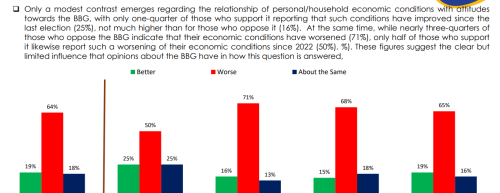
Nearly two-thirds of Kenyans (64 per cent) report that their family’s economic situation has worsened since the 2022 General Election, while only 19 percent say they are better off.
Ruto’s acid test
Even among supporters of the Broad-Based Government, half say their economic circumstances have deteriorated over the last four years.
“At the same time, the fact that half of those who support the BBG report that their economic situation has worsened since the last election (50%) suggests that political alignment reflects more than strictly economic factors,” TIFA observed.

The survey found that economic concerns dominate public priorities, with 70 per cent of respondents identifying inflation, high taxes, unemployment and poverty as the country’s most serious challenges.
While the Kenya Kwanza administration received its highest performance rating for reducing political tensions, only 25 per cent of respondents said life had improved in that area.
In contrast, taxation received the worst rating, with 74 per cent saying government policies had made life worse.
TIFA says that the BBG’s inability to boost public confidence stems from a simple reality: political stability alone is not enough.
For many Kenyans struggling with the cost of living, jobs and shrinking purchasing power, economic outcomes matter more than political handshakes.
As the country edges closer to the 2027 General Election, the survey signals that restoring public confidence may depend less on political alliances and more on whether households begin to feel genuine economic relief.