TIFA survey: Whatever happened to Ruto’s Singapore dream promise?
By Aloys Michael, June 4, 2026President William Ruto’s vision of transforming Kenya into an economic success story akin to Singapore was once a central pillar of his administration’s messaging.
Nearly four years into his presidency, however, a new Trends and Insights for Africa (TIFA) survey suggests that many Kenyans are struggling to see that dream reflected in their daily lives.
The findings released on Thursday, June 4, 2026, point to a widening gap between the government’s long-term economic ambitions and the immediate realities confronting households grappling with high living costs, taxation and shrinking purchasing power.
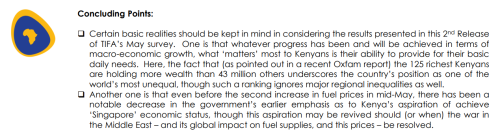
“There has been a notable decrease in the government’s earlier emphasis as to Kenya’s aspiration of achieve ‘Singapore’ economic status, though this aspiration may be revived should (or when) the war in the Middle East, and its global impact on fuel supplies and this prices be resolved,” the survey reads.
The observation comes at a time when public confidence in the country’s direction remains deeply pessimistic.
According to the survey, 74 per cent of Kenyans believe the country is headed in the wrong direction, compared to only 14 per cent who think Kenya is moving in the right direction.
The figures mirror growing concerns over the state of household finances. TIFA found that 64 per cent of respondents say their personal or family economic situation has worsened since the 2022 General Election, while only 19 per cent report an improvement.
“Largely reflecting the above economic realities, two-thirds of Kenyans again report a worsening of their economic conditions since the last election in 2022,” the survey states.
Dead cat strategy
As the United Democratic Alliance (UDA) chief maintains that the dream is intact, his critics see it as a dead cat strategy to coin his 2027 campaign slogan just like he did during 2022.
For instance, Wiper Patriotic Front Party leader Kalonzo Musyoka has scoffed at the idea, saying it is an empty façade which will not materialise for Kenya.
In an interview on a local TV station on Sunday, December 21, 2025, Kalonzo said the dream is unrealistic, especially when the economy is dwindling.
“How do you make Kenya Singapore when 6000 companies have migrated to Tanzania, to Uganda and our youth are unemployed? He posed.

“What Ruto has done is to throw a dead cat syndrome on the table.”
Incidentally, the Wiper chief drew a comparison with the Kenya Vision 2030, which he argues, despite having sustainable and realistic goals and objectives, has still not made the country punch above its weight since its birth.
“Kenya was supposed to be a middle-income country by 2030, with its citizens enjoying a high quality of life. How many Kenyans are able to put food on their table even as we go into Christmas? And you want to tell us that you want to take us to Singapore. This is a dead cat strategy,” Kalonzo said.
Kenyan leaders have long fantasised about turning the country into the Singapore of Africa, and Ruto has now revived the slogan with missionary zeal, vowing to drag Kenya into the ranks of high-income economies and has already unveiled his strategies.
Reality check

When Ruto campaigned for office under the Kenya Kwanza banner, he promised a Bottom-Up Economic Transformation Agenda that would empower hustlers, create jobs, boost agricultural production and expand economic opportunities for ordinary citizens.
His administration has since pointed to improved macroeconomic indicators, currency stability, increased agricultural output and infrastructure investments as evidence that the economy is on a recovery path.
Yet the TIFA findings suggest that many Kenyans measure economic success not through macroeconomic statistics but through their ability to meet daily needs.
“Whatever progress has been and will be achieved in terms of macro-economic growth, what ‘matters’ most to Kenyans is their ability to provide for their basic daily needs,” TIFA observed.
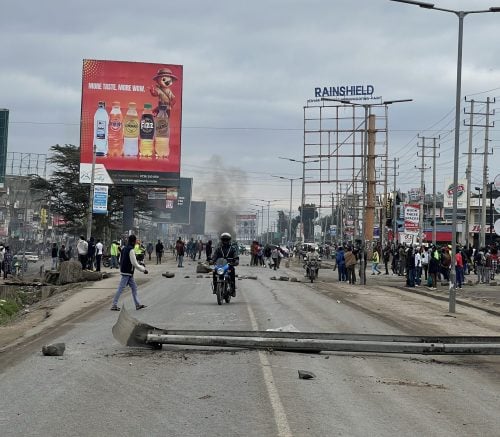
Economic concerns continue to dominate public discourse. Seven in ten respondents identified inflation, high taxation, unemployment and poverty as the country’s most serious problems. Specifically, 47 per cent cited inflation, high prices and taxes, while 23 per cent pointed to unemployment and poverty.
The poll also found that employment challenges remain stubbornly persistent. The proportion of unemployed Kenyans stands at 17 per cent, unchanged from the period around the 2022 election despite government promises to create jobs and stimulate enterprise growth.
Meanwhile, taxation has emerged as the government’s weakest-performing policy area. While Kenya Kwanza received its best rating for reducing political tensions, taxation attracted the most negative assessment, with 74 per cent saying government actions had made life worse.