TIFA pollster discloses the amount politicians are charged for opinion surveys
By Mabonga Makhanu, June 2, 2026TIFA survey lead researcher Tom Wolf has revealed that politicians are charged between Ksh30,000 and Ksh40,000 for a single question in an opinion poll.
While speaking during an interview with a local radio station on Tuesday, June 2, 2026, the pollster explained that the amount is charged based on a sample size of 2,000 respondents.
“Swali moja bei yake ni kati ya ksh30k na ksh40k kuuliza 2000 kwa sababu iko malipo ya gharama kadhaa” Tom Wolf
He added that the money is used to facilitate the movement of research teams across the country, cater for logistics, and meet other operational needs.
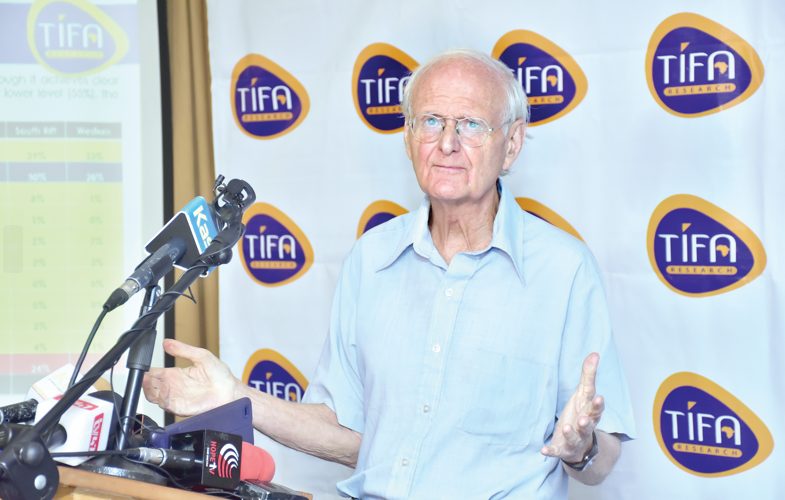
Tom Wolf further noted that for an opinion poll involving a sample size of 2,000 people, such as the one recently conducted to gauge the popularity of various presidential candidates and political figures, approximately Ksh2 million is required to effectively carry out the exercise.
He went on to intimate that this is a common phenomenon whenever a general election approaches, as many politicians seek the services of pollsters to gauge their popularity among voters.
“Nikikumbuka katika chaguzu za 2022 ilikuwa kawaida sisis kupata kazi kutoka kwa wanasiasa na wagombezi mbalimbali kutaka kujua watu wanaonaje kazi yetu katika nyadhifa mbalimbali, tukisjamaliza tunawauliza mnataka tupee wanahabari haya matokeo au laa
Kibaki laws
He further revealed that there is a law enacted during the tenure of the late President Mwai Kibaki that permits pollsters to conduct opinion surveys, provided they disclose who financed the survey for purposes of transparency.
However, he stated that this requirement mainly applies to companies and brands, such as those selling soaps and other household commodities, which seek to understand consumer behaviour and product usage. In the political arena, according to Tom Wolf, TIFA does not disclose the financiers of surveys, with the organisation instead taking ownership of the findings.
He went on to state that after next year’s party nominations, they are likely to receive an influx of politicians seeking opinion polls in their respective constituencies in order to understand their standing among voters and shape their campaign strategies.
At the same time, he argued that conducting opinion polls at the current stage may be a waste of money and resources since it remains difficult to accurately predict how the political landscape will shift after party nominations. Tom Wolf also disclosed that politicians who commission surveys have the final say on whether the results should be made public or remain confidential.
TIFA’s recent opinion poll
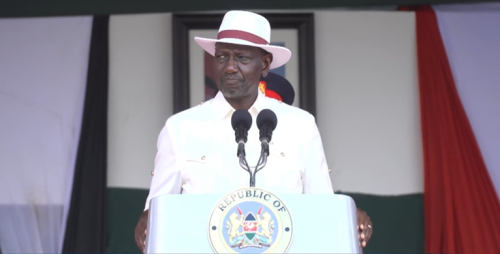
The researcher also defended TIFA’s recent opinion poll, which gave President William Ruto a popularity rating of 24 per cent. Wiper Party leader Kalonzo Musyoka came in second with 19 per cent, while former Interior Cabinet Secretary Fred Matiang’i followed closely with 17 per cent.
According to Tom Wolf, President Ruto’s popularity has been increasing gradually, while Kalonzo Musyoka’s rating dropped from 25 per cent in November to 19 per cent. Despite the decline, he noted that Kalonzo remains significantly ahead of where he was a year ago, when his presidential prospects stood at just 6 per cent.
Wolf also addressed political party popularity ratings, citing ODM’s dominance at 18 per cent despite a slight decline from 20 per cent recorded in November. He defended the drop, arguing that it may not be statistically significant since it falls within the survey’s margin of error of plus or minus two percentage points.
DCP’s significant rise
He further noted that the Democracy for Citizens Party (DCP) has recorded significant growth, with its popularity rising from 6 per cent in November to 16 per cent in the latest survey, making it one of the fastest-growing political parties in the country.