Survey indicates Kenyans have lowest trust in Ruto – TIFA
By Aloys Michael, June 4, 2026President William Ruto is facing a growing crisis of public confidence, with a new Trends and Insights for Africa (TIFA) survey showing that Kenyans have among the lowest levels of trust in his leadership amid worsening economic hardships and rising dissatisfaction with the country’s direction.
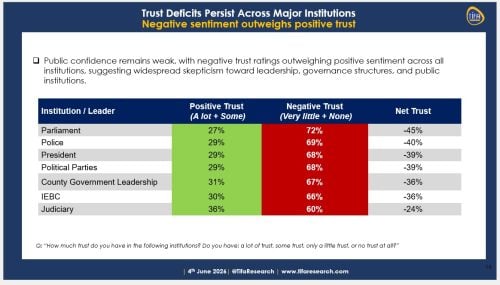
The survey, conducted between May 2 and May 11, 2026, found that only 29 per cent of Kenyans expressed positive trust in President Ruto, while 68 per cent said they had little or no trust in him, giving the Head of State a net trust rating of minus 39 per cent.
Among the institutions assessed, only Parliament performed worse, with a net trust rating of minus 45 per cent.
The findings come as the Kenya Kwanza administration faces mounting criticism over the high cost of living, taxation and shrinking household incomes nearly four years after Ruto swept to power on the promise of empowering ordinary Kenyans through his Bottom-Up Economic Transformation Agenda (BETA).
During the 2022 campaign, Ruto positioned himself as the champion of hustlers, including boda boda riders, mama mboga traders, small-scale farmers and unemployed youth. His administration pledged to unlock economic opportunities through initiatives such as the Hustler Fund and policies aimed at inclusive growth.
However, a recent Bertelsmann Transformation Index (BTI) 2026 Country Report says the government inherited a debt-laden economy and responded by removing fuel and maize subsidies while introducing new taxes to stabilise public finances.
The result, according to the report, was soaring prices for basic commodities and increased pressure on households.
The economic frustrations reflected in the BTI report are echoed strongly in the TIFA survey.
Ruto’s economic paradox
According to TIFA, nearly two-thirds of Kenyans (64 per cent) say their family’s economic situation is worse today than it was when Ruto took office in 2022, while only 19 percent report being better off.

“Economic sentiment remains fragile, with nearly two-thirds of households still reporting that they are worse off compared to the last election, suggesting that perceptions of recovery have yet to translate into lived experience,” the survey notes.
Public dissatisfaction is also reflected in views about the country’s overall direction. A staggering 74 per cent of respondents said Kenya is heading in the wrong direction, compared to just 14 per cent who believe the country is on the right path.
“Public sentiment has shifted decisively negative, with nearly three-quarters of Kenyans now saying the country is heading in the wrong direction,” TIFA observes.
Economic concerns dominate public discourse. When asked to identify the country’s most serious problem, 47 per cent cited inflation, high prices and taxation, while another 23 per cent pointed to unemployment, poverty and the weak economy.
Combined, seven out of ten Kenyans identified economic issues as the country’s biggest challenge.
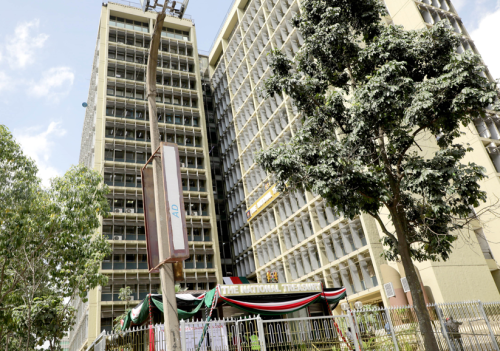
The survey further reveals widespread anger over taxation, which emerged as the worst-rated area of government performance. Only 7 per cent said government policies had improved life through taxation measures, while 74 per cent said taxes had made life worse, producing a net rating of minus 67 percent.
TIFA says that the country’s deteriorating economic conditions are directly influencing perceptions of leadership and governance.
“Public confidence remains weak, with negative trust ratings outweighing positive sentiment across all institutions, suggesting widespread scepticism toward leadership, governance structures and public institutions,” the survey states.
The findings intensify political pressure on Ruto as he seeks to defend his economic agenda ahead of the 2027 General Election.
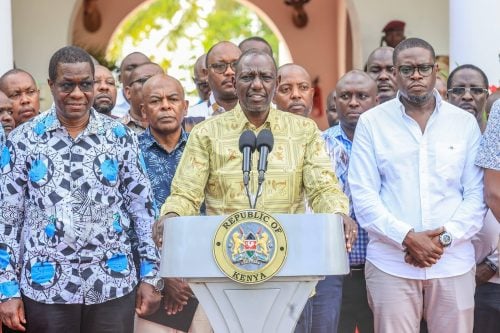
While the government continues to point to macroeconomic gains, improved agricultural output and infrastructure expansion, both the TIFA survey and KNBS data suggest many Kenyans are yet to feel those gains in their daily lives.
For instance, In his 2025 State of the Nation Address, President Ruto said national maize production had risen from 44 million bags in 2022 to 67 million bags in 2024, adding that the country was on course for a historic 70 million-bag harvest.
Yet KNBS data tells a far more modest story.According to the survey, maize production increased by only 2.4 per cent to 45.8 million bags in 2025, a figure significantly below the numbers repeatedly cited by the president.
The discrepancy feeds into a broader public concern that official messaging is increasingly detached from everyday realities.
Sugar production presents another troubling example.While the president claimed the sector was stabilising, with production surging by 76 per cent, KNBS data showed sugarcane production actually fell by 24.7 per cent to 7.05 million tonnes.
Even flagship projects central to the bottom-up narrative are facing scrutiny.For millions of hustlers who backed Ruto’s promise of economic transformation, the reality remains one of rising prices, stagnant incomes and growing disillusionment with a government that pledged to ease their burden.