Safina Party calls for public stake in Safaricom amid govt divestment
By Faith Lagat, December 5, 2025The Safina Party has intensified its opposition to the government’s plan to sell a 15 per cent stake in Safaricom to South Africa’s Vodacom, demanding that any divestment must prioritise direct ownership by Kenyan citizens rather than foreign entities.
Willis Otieno, the party’s deputy president designate, criticised the Ksh244 billion transaction announced this week, describing it as a reckless liquidation of a strategic national asset to cover fiscal mismanagement.
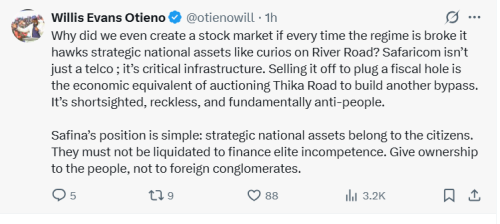
“Why did we even create a stock market if every time the regime is broke it hawks strategic national assets like curios on River Road? Safaricom isn’t just a telco; it’s critical infrastructure. Selling it off to plug a fiscal hole is the economic equivalent of auctioning Thika Road to build another bypass. It’s shortsighted, reckless, and fundamentally anti-people,” Otieno posted on X on December 5, 2025.
Also watch: MP Nyoro opposes Safaricom stake sale, says Kenyans are being short-changed
In a follow-up statement, he added: “Safina’s position is simple: strategic national assets belong to the citizens. They must not be liquidated to finance elite incompetence. Give ownership to the people, not to foreign conglomerates.”
Treasury defends sale as value unlocking
Treasury Cabinet Secretary John Mbadi has defended the deal, which includes USD 1.56 billion (Ksh204 billion) plus a Ksh40.2 billion dividend advance, insisting it is not a distressed sale but a deliberate strategy to “unlock value from a mature investment.”
“First of all, I want to make it very clear that what we are doing is what we call unlocking value for a mature investment. The Safaricom PLC, as an investment for the Republic of Kenya as it is today, is a mature investment, and that is what you can unlock,” Mbadi said in an interview on December 4, 2025.
He stressed that the proceeds will fund a national infrastructure fund to attract private-sector participation in roads, energy, and other capital projects.
“Now depending on where you invest this money… the fear maybe Kenyans have here is that we are divesting in Safaricom 15 percent, getting this money and consuming it or putting it in budgetary support.
That is not what we intend to do,” the CS added. He argued that, with taxation and further borrowing off the table, divestiture remains the only viable option for financing growth-enabling infrastructure. The government will retain majority control and continue receiving about Ksh10 billion annually in dividends, foregoing only Ksh7 billion a year.
Critics question valuation, timing
The transaction has also faced pushback from Kiharu MP Ndindi Nyoro, who contends the shares are being sold at Ksh34 each, significantly undervaluing the telecom giant.
Despite the criticism, the Treasury maintains the timing is appropriate given technological shifts and Safaricom’s regional expansion needs.
The Ksh244 billion from the sale is set to capitalise both the National Infrastructure Fund and the Sovereign Wealth Fund. Safina Party insists the conversation must focus on direct public ownership of Kenya’s most valuable company rather than foreign acquisition.