Advertisement
Ruto is Kenyans’ top choice in 2027 presidential race – TIFA
Thursday 14th May, 2026 01:42 PM|

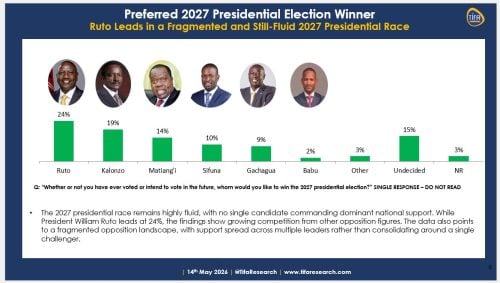
President William Ruto has emerged as the leading choice to win the 2027 presidential election, according to a new survey released by TIFA Research on May 14, 2026.
The poll places Ruto at 24 per cent support, ahead of Kalonzo Musyoka at 19 per cent and Fred Matiang’i at 14 per cent.
Edwin Sifuna follows with 10 per cent, while former deputy president Rigathi Gachagua stands at 9 per cent. Other candidates account for 3 per cent, while 15 per cent of respondents remain undecided.
The survey asked Kenyans whom they would like to see win the 2027 presidential election, regardless of whether they intend to vote.
You Might Also Like

TIFA said the race remains competitive despite Ruto holding the strongest single position.
“The 2027 presidential race remains highly fluid, with no single candidate commanding dominant national support,” the report stated.
Trend data from May 2025 to May 2026 shows Ruto steadily improving his position. His support rose from 18 per cent to 24 per cent over the period, while the number of undecided voters dropped from 24 per cent to 15 per cent.
The findings suggest that voter preferences are beginning to harden ahead of the next election, increasing pressure on opposition leaders to form alliances.
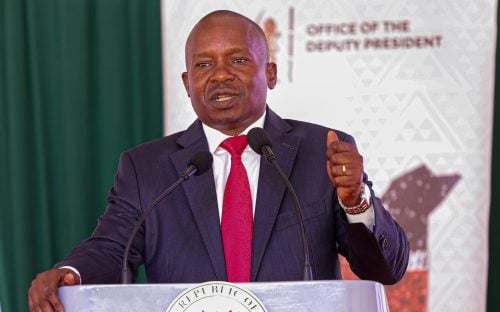
The poll also found that Ruto supporters strongly favour Kithure Kindiki as the president’s preferred running mate for 2027.
Kindiki received 59 per cent support among Ruto’s base, far ahead of Gladys Wanga at 12 per cent. Oburu Odinga and Hassan Joho each scored 3 per cent, while Musalia Mudavadi got 2 per cent and Moses Wetangula received 1 per cent.
TIFA said many voters view Kindiki as the safest option for continuity within the Kenya Kwanza administration.
“Kindiki is viewed as the most politically acceptable deputy option,” the report noted.
DCP rise reshapes politics
Kindiki’s record in government appears to have strengthened his standing among supporters. During his time as Interior Cabinet Secretary, he oversaw passport reforms, security modernisation and efforts to address banditry in parts of the North Rift.
The survey also highlighted shifting political dynamics across parties.
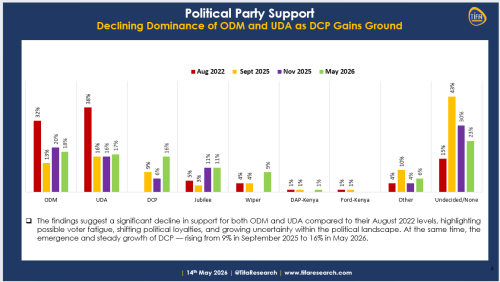
Support for ODM and UDA has dropped compared to the period immediately after the 2022 election, while DCP has continued to grow.
According to the findings, DCP now stands at 16 per cent support, placing it close to ODM at 18 per cent and UDA at 17 per cent.
Political analysts say the rise of DCP reflects growing frustration among voters with established political parties.
Inside ODM, the poll revealed a clear split between rival factions.
About 73 per cent of ODM supporters backed the ‘Linda Mwananchi’ faction linked to Sifuna and leaders calling for a stronger opposition role. Another 24 per cent supported the “Linda Ground” camp associated with Oburu Odinga.
The findings suggest many ODM supporters now prefer a more independent opposition approach instead of closer cooperation with the government.
The survey further showed that ethnic political influence remains strong across the country.
Kalonzo was recognised by 93 per cent of Kamba respondents as their leading political figure, while Matiang’i led among Kisii respondents with 83 per cent support.
Ruto topped the Kalenjin category at 73 per cent, while Gachagua led among Kikuyu respondents at 70 per cent.
Political observers expect coalition talks and political realignments to intensify as parties prepare for the 2027 contest.
Author
Kenneth Mwenda
Kenneth Mwenda is a business, sports, and politics digital writer with over seven years of experience in journalism, covering breaking news, feature stories, and in-depth analysis across a range of beats.
For inquiries, he can be reached at [email protected]
View all posts by Kenneth MwendaLatest News






Advertisement
More on Inside Politics