Orengo: There is no legal document to justify broad-based govt
By Ndiritu Wanjiru, May 6, 2026Siaya Senator James Orengo has cast doubt on the legality and formal existence of the broad-based government arrangement between the United Democratic Alliance (UDA) and the Orange Democratic Movement (ODM), saying there is no written or signed agreement to support its formation.
Speaking in an exclusive interview with K24 TV on Wednesday, May 6, 2026, Orengo has revisited the political history of Kenya. In the history of coalition governments, Orengo made a comparison that drew on the history of the grand coalition government that was formed during the late Mwai Kibaki’s time.
“We discussed with the late Raila Odinga about the broad-based government, and he said that there was no agreement that was signed that ODM and UDA have formed a broad-based government… Being in a coalition government is a serious matter, and there is no legal document,” Orengo said.
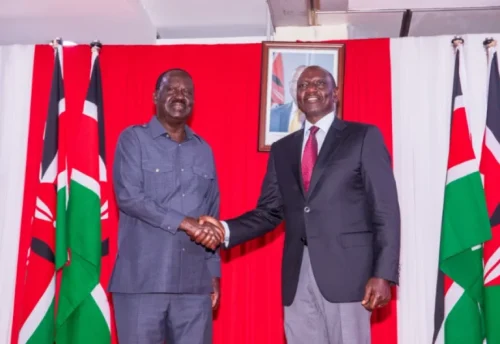
Orengo noted that, unlike during the Kibaki-Raila coalition era, there is no formal legal document indicating that UDA and ODM have made any structured coalition or power-sharing agreement.
“But if you ask our colleagues if there is any legal instrument or anything that would show that UDA and ODM have formed the broad-based government, there is nothing like that,” Orengo added.
Orengo also cited talks purportedly conducted with the late ODM Party leader Raila Odinga in which the veteran opposition leader said that the talks were a political understanding but not a formal coalition agreement.
The governor has noted that the late Raila’s intent of entering into the coalition government was in regard to the protection of members who had already been appointed to government. Otherwise, it would have implied that ODM lost close and loyal allies who had already been absorbed into the system, Orengo observed.
Question on House leadership
Orengo also raised the issue of how leadership in the National Assembly and the Senate is organised and pointed out that leadership positions of the minority parties are still occupied by the ODM party.
He contended that in the event that there was an actual broad-based government in legal and constitutional terms, those changes would have been anticipated in the parliament in the leadership positions to reflect a formal arrangement of a coalition.

He particularly expressed worries as to why the minority leadership positions in the two houses had not been changed, arguing that the discrepancy underpins arguments that there is a structured government of power sharing.
Had the broad-based government been legal, he said, there would have been changes in the leadership of the Senate and the National Assembly.
Orengo insisted that even the late ODM leader Raila Odinga had earlier stated that such parliamentary positions could not be simply forfeited, making the interpretation of the current political arrangement even more difficult.