ODM is the most popular party in Kenya -TIFA survey
By Aloys Michael, December 23, 2025Even after the death of former opposition veteran Raila Odinga, the Orange Democratic Movement (ODM) Party still occupies more political space on the political chessboard.
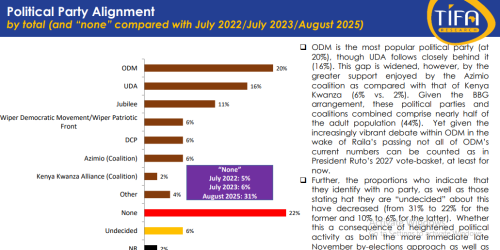
This is according to the latest report released by TIFA on Tuesday, December 23, 2025, which shows that the faction leads at 20 per cent against the United Democratic Alliance (UDA) at 16 per cent.
“This gap is widened, however, by the greater support enjoyed by the Azimio coalition as compared with that of Kenya Kwanza,” the report explains.
The two top factions continue to enjoy more political space despite efforts by the United Opposition to wane their influence.
Jubilee Party claims the share of being the third most popular political party at 11 per cent.
The retired President Uhuru Kenyatta’s faction is, however, keen to solidify its turf ahead of the 2027 polls, especially after endorsing former Interior and Education Cabinet Secretary Fred Matiang’i to run for the country’s top seat.
Surprisingly, Former Deputy President Rigathi Gachagua’s Democracy for Citizens (DCP) Party tied with Wiper Patriotic Front Party of Kalonzo Musyoka at 6 per cent.
The two leaders have been at the forefront of bareknuckling ODM and UDA led by President William Ruto and now Siaya Senator Oburu Oginga, aiming to cement their political popularity to unseat Ruto in his reelection bid.
“Given the Broad-based government arrangement, these political parties and coalitions combined comprise nearly half of the adult population (44 per cent), the survey observes.
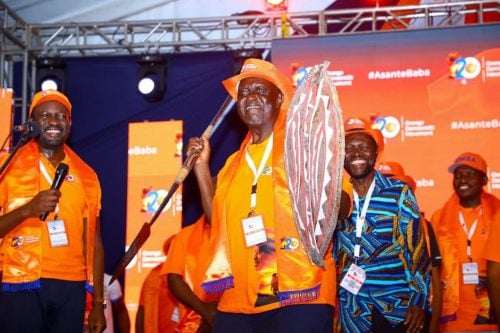
Coalition support
“Yet given the increasingly vibrant debate within ODM in the wake of Raila’s passing, not all of ODM’s current numbers can be counted as in President Ruto’s 2027 vote-basket, at least for now.”
Azimio Coalition again is leading at 6 per cent, while Kenya Kwanza is supported by 2 per cent of Kenyans.
Further, the proportions who indicate that they identify with no party, as well as those stating that they are “undecided” about this, have decreased from 31 per cent to 22 per cent for the former and 10 per cent to 6 per cent for the latter.
Whether this is a consequence of heightened political activity as both the more immediate late November by-elections approach, as well as the 2027 contests themselves, is unclear.