Nyutu warns Sakaja-Ruto deal threatens Nairobi devolution integrity
By Aloys Michael, February 18, 2026Murang’a Senator Joe Nyutu has raised alarm over what he describes as a worrying bypass of public participation and county oversight following the signing of a collaboration between Nairobi County and the national government.
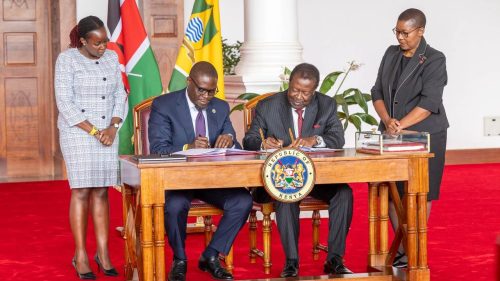
The deal, formalised at State House on February 17, 2026, is intended to coordinate county and national functions and fast-track key projects such as roads, housing, water, and waste management.
However, critics argue that it raises serious questions about transparency, accountability, and the future of devolution in Kenya.
In an interview on a local TV station on Wednesday, February 18, 2026, Nyutu questioned the substance of the deal, asking whether Nairobi County is truly able to control its own resources or whether loopholes in the agreement will drain funds meant for local service delivery.
“Resources should follow functions, not vice versa. What we are seeing is NMS back under a different name. The big question is: is Nairobi collecting its own source revenue, or are there loopholes causing the city to lose funds it could have used to enhance service delivery? Was public participation held? Was the County Assembly involved?” he asked.
Even so, Governor Johnson Sakaja defended the deal as a historic step for Nairobi, describing it as thirteen years overdue, saying that it would allow the capital to leverage its unique position to attract resources, attention, and support that had previously been inaccessible.
“With a population of close to 7 million residents and with the city growing year on year, the equitable share from the division of revenue that provides resources to all the counties, as well as our own source revenue, can never be enough for the demanding needs of a capital city of the stature that we aspire to be,” he stated.

However, the governor’s assurances have done little to quell unease among legislators, who see the deal as a continuation of the failed Nairobi Metropolitan Services (NMS) model, merely repackaged.
Embakasi North Member of Parliament James Gakuya has described the agreement as a loophole that could enable corruption and mismanagement of public funds, noting that the county already has planned budgets for the roles detailed in the pact, arguing that the deal effectively weakens the county government by creating joint structures that mirror the NMS system, where functions are coordinated with the national government but ultimate responsibility remains unclear.
“This is one way of money laundering because the county government had planned on street lighting, garbage collection, and water management, among other services, and we have not been told about the reallocation of the funds that had been allocated to these projects,” Gakuya said during an interview on Kameme TV.
Sakaja-Ruto deal loopholes
The Ksh80 billion pact has many loopholes, as county functions such as waste management, roads, housing, markets, and water are now subject to collaboration with the national government without following the Article 187 procedure for function transfer.
The steering committee, chaired by the Prime Cabinet Secretary with the governor relegated to vice-chair, structurally places Nairobi County in a subordinate position.
Clauses permitting collaboration in such other areas allow the scope of the agreement to expand without limits, while financing and procurement responsibilities remain vague.

Moreover, accountability is blurred, oversight is weak, and reporting mechanisms bypass the County Assembly, raising concerns about democratic oversight and adherence to the principles of devolution.
Public participation is vaguely referenced but without clarity on timing, scope, or enforcement, leaving citizens effectively excluded from decisions that affect their city.
Nyutu framed the agreement as a political manoeuvre with profound implications for the future of Nairobi’s governance, warning that central government dominance over county functions sets a dangerous precedent.

“The county must be empowered to collect its revenues and make decisions on service delivery. Anything short of that undermines devolution. We are effectively watching a return of centralised control under a new label,” he said.
While the deal promises accelerated infrastructure development and a framework for coordination between county and national authorities, the controversy highlights a deeper political tension.
On one hand, the national government is asserting its influence over the capital; on the other, county leaders and legislators are demanding that devolution be respected, public funds safeguarded, and citizens involved in the decisions that directly affect their services.
How this balance is managed will likely define the political landscape in Nairobi for years to come, with potential ramifications for the broader devolution framework in the country.