Ndindi Nyoro to address the press for first time after skipping Finance Bill vote
By Mustafa Juma, June 27, 2026Kiharu Member of Parliament (MP) Ndindi Nyoro is set to address the media for the first time since missing the parliamentary vote on the Finance Bill 2026, a decision that sparked widespread public debate and criticism.
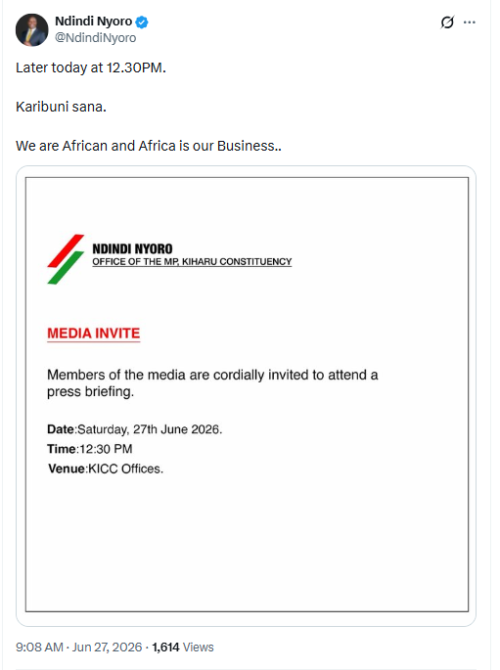
Nyoro’s office announced on Saturday, June 27, 2026, that the lawmaker will hold a press briefing at the Kenyatta International Convention Centre (KICC) offices beginning at 12:30 p.m.
“MEDIA INVITE. Members of the media are cordially invited to attend a press briefing. Date: Saturday, 27th June 2026. Time: 12:30 PM. Venue: KICC Offices,” the press invite reads.
The announcement has immediately fuelled speculation that the Kiharu legislator could use the opportunity to explain his absence during one of Parliament’s most consequential votes or outline his political position on the Finance Bill 2026 and the country’s economic direction.
Spotlight after missing Finance Bill vote
Nyoro has been at the centre of public attention since he failed to participate in the National Assembly vote on the Finance Bill 2026.
The Bill was passed after 122 Members of Parliament voted in favour, while 40 voted against the proposed tax and revenue measures that will shape government financing for the 2026/27 financial year.
The relatively low turnout during the vote attracted criticism, with many Kenyans questioning why several lawmakers, including Nyoro, were absent from the House despite the significance of the legislation.
His absence was particularly notable given his reputation as one of Parliament’s most outspoken voices on public finance, taxation and budget oversight.
Before leaving the Budget and Appropriations Committee chairmanship, Nyoro had frequently challenged government borrowing and fiscal policy, earning recognition as one of the legislature’s leading voices on economic matters.
Nyoro breaks silence
Days after the vote, Nyoro acknowledged the criticism and accepted responsibility for failing to participate.
In a statement posted on his X account, the MP explained that he had travelled outside the country on official engagements that could not be postponed.
“The vote for the Finance Bill happened yesterday; disappointingly, I was not in Parliament. I travelled out of the country on Wednesday evening for engagements that could not have been postponed. No explanation should absolve the blame,” he wrote.
He added that he had listened to public criticism with humility.
“As for the feedback we have received from all Kenyans, we take it with humility.”

Nyoro defends record on economic debate
While apologising for his absence, Nyoro maintained that he has consistently participated in debates surrounding Kenya’s fiscal policy and major financial legislation.
“We have always been available and forthright in debating both the Appropriations Bill and the Finance Bill on the committee and on the floor of the House as a commitment to giving a different and alternative view,” he said.
The MP has previously criticised what he considers excessive government borrowing, warning that Kenya should prioritise prudent fiscal management instead of accumulating debt.
“I ask this government: do you want to break the record of borrowing? I think the better records to break are the records of good governance, not the records of profligate borrowing as we see it now,” Nyoro said in one of his recent critiques of the government’s economic policy.
Raises concerns over Parliament’s oversight role
Nyoro also used his statement to express concern over what he described as changing political dynamics within Parliament.
According to the legislator, effective oversight has become increasingly difficult because the leadership of both the Majority and Minority sides now frequently take similar positions on key government legislation.
“Parliament is in an unprecedented phase where both the Majority and the Minority leadership are on the same side, thereby making it difficult to effectively act as an institution of oversight,” he said.
He argued that this environment has compelled some legislators to pursue alternative avenues for engaging the public on matters of governance and economic policy.