Matiang’i or Kalonzo? Who is opposition’s best candidate to take on Ruto? TIFA report answers
By Ndiritu Wanjiru, May 14, 2026Kenya’s political landscape ahead of the 2027 General Election is becoming increasingly defined as voter preferences gradually consolidate around recognisable leaders, political factions, and competing ideologies.
According to polling trends released by TIFA Research on Thursday, May 14, 2026, the research shows that while the opposition remains fragmented, voters are slowly moving away from indecision toward clearer political alignments.
“The 2027 presidential race remains competitive but is becoming more defined, with President William Ruto currently holding the strongest individual position. The emergence of Edwin Sifuna and Rigathi Gachagua also points to a shifting political landscape,” the TIFA report stated
“Meanwhile, the declining undecided vote suggests that voter preferences are beginning to crystallise, increasing the importance of coalition-building and voter consolidation ahead of 2027,” TIFA added.
At the same time, internal divisions within the Orange Democratic Movement (ODM) are emerging as a major factor shaping the future of opposition politics, particularly through the rise of the “Linda Mwananchi” movement linked to Edwin Sifuna.
Ruto tops polls
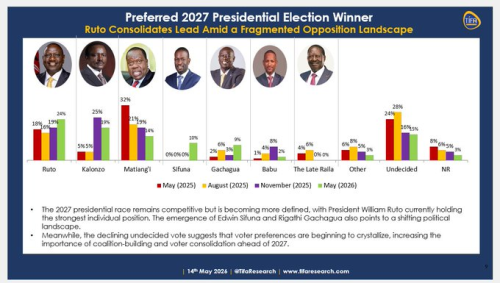
The research further indicates that President William Ruto, deputised by Kithure Kindiki, currently maintains the strongest and most stable position among potential presidential contenders. His support steadily rose from 18 per cent in May 2025 to 24 per cent by May 2026, suggesting growing consolidation of his political base as opposition leaders struggle to unite behind a single challenger.
Kalonzo shines in opposition
Within the opposition, support remains divided among several key figures. Kalonzo Musyoka experienced a sharp rise from 5 per cent in May and August 2025 to 25 per cent in November 2025 before declining slightly to 19 per cent by May 2026. The fluctuations highlight both his continued relevance and the unstable nature of voter loyalty within the opposition.
Meanwhile, Fred Matiang’i, who initially emerged as one of the strongest challengers with 32 per cent support in May 2025, has steadily lost momentum, dropping to 14 per cent by May 2026. The decline points to difficulties in sustaining national appeal and consolidating alliances in an increasingly competitive opposition environment.
Sifuna factor
Newer political figures are also gaining traction nationally. Edwin Sifuna, who had no measurable support throughout 2025, rose to 10 per cent by May 2026, signalling growing national visibility and resonance among voters seeking a more confrontational, citizen-focused opposition voice. Similarly, Rigathi Gachagua increased from 2 per cent to 9 per cent during the same period, showing his emergence as an influential political figure outside traditional power structures.
One of the most notable trends is the sharp decline in undecided voters. Undecided respondents accounted for 24 per cent in May 2025 and rose to 28 per cent in August 2025, reflecting widespread uncertainty at the time. However, the figure dropped significantly to 16 per cent in November 2025 and further to 15 per cent by May 2026. The “No Response” category also fell from 8 per cent to 3 per cent. This suggests Kenyan voters are increasingly settling into political camps despite the absence of formal coalitions.
ODM factions
The consolidation is especially visible within ODM, where a growing split has emerged between the “Linda Mwananchi” and “Linda Ground” factions. The “Linda Mwananchi” camp, associated with Edwin Sifuna, advocates for an independent, people-centred opposition focused on defending citizens and holding government accountable. The “Linda Ground” faction, linked to Oburu Odinga, favours closer cooperation with the government as a pragmatic political strategy.
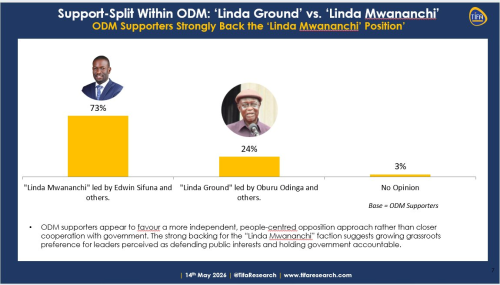
Polling among ODM supporters shows overwhelming backing for the “Linda Mwananchi” movement, with 73 per cent supporting Sifuna’s position compared to 24 per cent for the “Linda Ground” approach. The findings reflect growing grassroots frustration over economic hardship, governance concerns, and perceptions that opposition parties should play a stronger watchdog role.