Advertisement
Ledama warns against funding new projects in the FY2026/27 budget before clearing debts
Monday 04th May, 2026 07:58 AM|

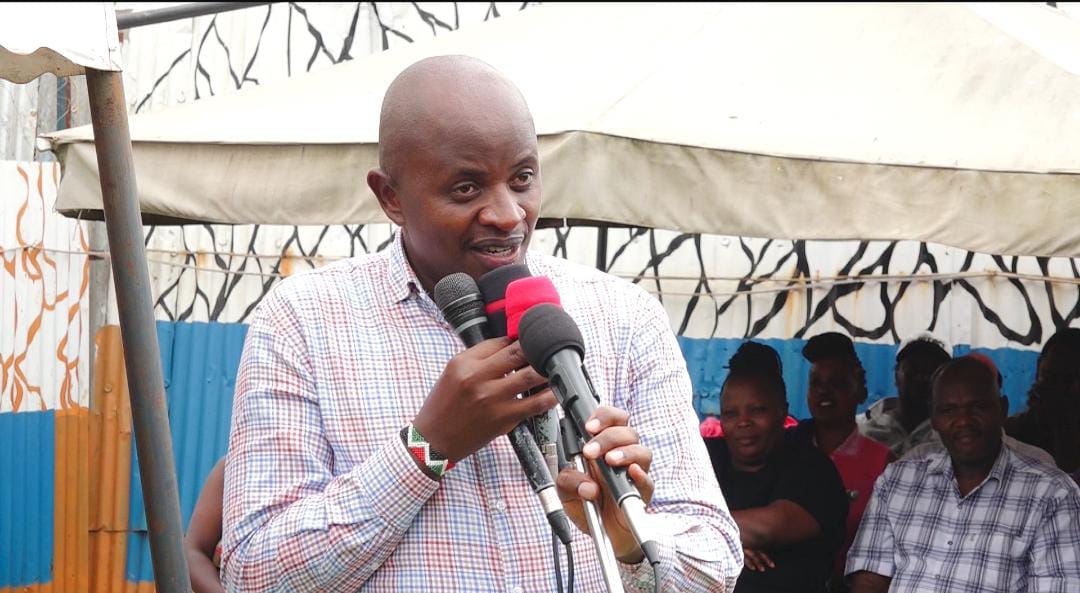
Narok Senator Ledama Olekina has called on the government to stop financing new projects in the 2026/2027 financial year until it clears existing obligations, completed projects, and verified pending bills.
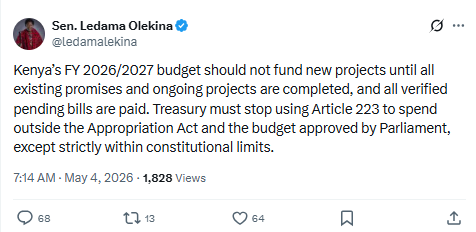
In a post on his X account on Monday, May 4, 2026, the Narok senator said Kenya should focus first on what it has already committed to before launching fresh programmes under the next budget cycle.
He said the government should not allow new spending while old promises remain unfinished. He also raised concern over unpaid bills and ongoing projects that, in his view, continue to stall due to poor prioritisation.
“Kenya’s FY 2026/2027 budget should not fund new projects until all existing promises and ongoing projects are completed, and all verified pending bills are paid,” Ledama wrote.
You Might Also Like
He also questioned the use of Article 223 of the Constitution, saying Treasury should not use it to spend outside the approved budget unless strictly allowed by law. He argued that Parliament must retain control over public spending through the Appropriation Act.
“Treasury must stop using Article 223 to spend outside the Appropriation Act and the budget approved by Parliament, except strictly within constitutional limits,” he added.
His remarks come at a time when the government is preparing to implement a Ksh4.82 trillion budget for the 2026/27 financial year. The plan, approved by the cabinet earlier in the year, sets out increased spending across key sectors including education, health, infrastructure, agriculture, and security.
Debt and spending concerns rise
The estimates show that the government plans to spend Ksh4.82 trillion, the highest in Kenya’s history. To finance this, the Treasury expects to raise Ksh3.63 trillion in revenue, leaving a deficit of about Ksh1.1 trillion.
The government plans to bridge the gap through borrowing, with Ksh116.2 billion expected from external lenders and Ksh995.7 billion from the domestic market, marking the highest local borrowing level in the country’s history.
At the national level, the executive will control the largest share of spending, taking about Ksh2.8 trillion out of Ksh2.89 trillion allocated to the national government. Parliament will receive Ksh48.69 billion, while the Judiciary will get Ksh30.44 billion.
Development spending at the national level stands at Ksh749 billion, while recurrent expenditure takes the larger share at Ksh3.54 trillion, covering salaries, operations, maintenance, and debt servicing.
The budget also allocates Ksh420 billion to county governments, maintaining support for devolved units, while Consolidated Fund Services takes Ksh1.5 trillion, mainly for debt obligations.
Treasury expects ordinary revenue to reach Ksh2.99 trillion, up from the previous year’s target of Ksh2.78 trillion.
Government strategy for the year is anchored on the Bottom-Up Economic Transformation Agenda (BETA), which focuses on agriculture, MSMEs, healthcare, housing, and the digital economy. Officials say the aim is to boost growth, create jobs, and reduce the cost of living.
But concerns over debt, pending bills, and unfinished projects remain a major issue in public finance management. Kenya continues to struggle with delayed payments to contractors and suppliers, which has slowed down project delivery in several sectors.
Ledama’s statement adds to growing calls for tighter fiscal discipline and better prioritisation of public spending. He insisted that the government must first complete what it has already started. In his view, this would reduce waste, improve accountability, and restore confidence in public budgeting.
As Parliament prepares to review the Finance Bill 2026 and other budget-related legislation, debates over spending priorities and debt management are expected to take centre stage.
Author
Kenneth Mwenda
Kenneth Mwenda is a business, sports, and politics digital writer with over seven years of experience in journalism, covering breaking news, feature stories, and in-depth analysis across a range of beats.
For inquiries, he can be reached at [email protected]
View all posts by Kenneth MwendaLatest News

Advertisement
More on Inside Politics