Lawyer Willis Otieno blasts govt over SHA software cost
By Cynthia Lodite, April 23, 2026City Lawyer Willis Otieno has criticised the Kenya Kwanza Administration for the purchase of the Social Health Authority( SHA) system, claiming funds could instead build hospitals in underserved areas.
In a post on his official X account on Thursday, April 23, 2026, Otieno explained that the government could instead use the Ksh104 billion funds to support school feeding, expand electricity and water access.
Further adding that such funds could have been moved to capitalise on youth funds, hire teachers and health workers, or create graduate unemployment support.
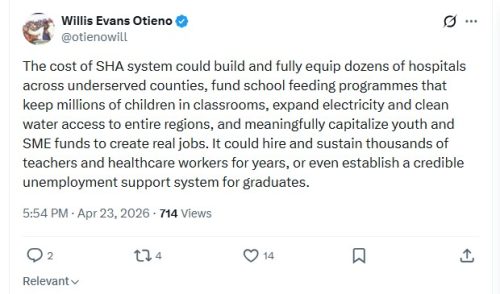
“The cost of the SHA system could build and fully equip dozens of hospitals across underserved counties, fund school feeding programmes that keep millions of children in classrooms, expand electricity and clean water access to entire regions, and meaningfully capitalise youth and SME funds to create real jobs,” Willis explained.
On his part, the Ksh104 billion IT system procurement is a major expense within SHA implementation, fueling debates on whether centralised health financing delivers better value than direct investments in facilities, education, and jobs.
“It could hire and sustain thousands of teachers and healthcare workers for years, or even establish a credible unemployment support system for graduates,” he added.
SHA software cost
Worth noting, the government’s ambitious Kshs104.8 billion Social Health Authority software purchase faced intense scrutiny after Auditor General Nancy Gathungu revealed that, despite massive public investment, the state neither owns nor controls the system.
The report, which was released in 2025, raises serious concerns about the government’s decision to proceed with the project without first establishing ownership of the system’s infrastructure and intellectual property.
“The ownership of the system, system components, and all intellectual property rights shall remain in the ownership of the consortium,” Gathungu noted in the report, warning that this severely limits the government’s authority and oversight.
Meanwhile, the arrangement meant that Kenya’s Social Health Authority contributions and claims from health facilities will be used to fund a system that the State does not own, which, at the time, the Auditor General described as posing a significant risk to public funds and healthcare delivery.
To add to the controversy, the procurement process did not include competitive bidding, instead sourcing the contractor directly through a Specially Permitted Procurement Procedure, which is a clear violation of Article 227(1) of the Kenya Constitution 2010.
“This process was contrary to Article 227(1) of the Constitution, which requires a fair, equitable, tranFsparent, competitive and cost-effective way of acquiring goods and services,” Gathungu stated.
According to the report, the project was also excluded from the procurement plan and the medium-term budgetary expenditure framework, which violated Section 53(7) of the Public Procurement and Asset Disposal Act of 2015.