Kaluma backs Raila’s national dialogue amid youth tension
By Aloys Michael, July 13, 2025Homa Bay Town Member of Parliament Peter Kaluma has weighed in on the proposed national intergenerational dialogue recently suggested by ODM leader Raila Odinga.
The dialogue, which was urged on Saba Saba Day, aims to foster unity among Kenyan youths around a common cause.
Odinga framed it as a patriotic gesture to bridge generational gaps and unite young people in constructive discourse, a move that now Kaluma acknowledges the former Prime Minister’s intentions.
“Baba, you mean well for Kenya. You are a true patriot,” he said, adding that this recognition highlights Raila’s long-standing commitment to national cohesion and social progress.
However, Kaluma was cautious in his assessment of the current youth movements in Kenya. He differentiated between genuine youth activism and what he described as disruptive elements.
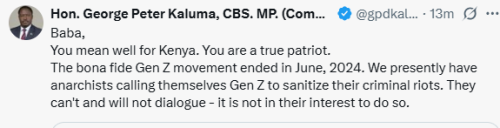
According to Kaluma, the “bona fide Gen Z movement ended in June 2024.” He implied that the movement’s official phase had concluded and that current groups claiming to represent Gen Z are not aligned with the original movement’s ideals.
The MP went further to criticise certain youth factions involved in recent unrest, describing them as “anarchists calling themselves Gen Z to sanitise their criminal riots.”
He drew a sharp divide between peaceful youth activism and violent protests that have occasionally erupted in the country. He firmly asserted, “They can’t and will not dialogue – it is not in their interest to do so.”
Raila‘s youth talk
The ODM honcho is advocating for an inclusive, intergenerational national dialogue to help Kenya navigate its challenges and establish a peaceful and sustainable future amid rising unrest and political agitation.
Addressing the press during the 35th commemoration of Saba Saba, the leader of the Orange Democratic Movement proposed a national conclave that would unite voices from across various divides to craft necessary reforms aimed at strengthening the country’s governance.
According to Raila, the outcomes of this dialogue should be subjected to a national referendum, allowing all Kenyans to have a say in their nation’s future.
“I propose an inclusive intergenerational national conclave to hear our people across all divides and come up with irreducible reforms and changes necessary to take the country forward,” Raila stated.

Reflecting on Saba Saba, Odinga reiterated that the movement, commemorated on July 7, was rooted in the landmark pro-democracy rally of 1990. He described it as inclusive, intergenerational, and non-partisan, representing a united struggle for freedom, equality, and constitutional reform that transcended communities, generations, professions, and political affiliations.
“Saba Saba was not one group against the entire nation; it was not community against that community or this age against that age. The movement stood for peaceful and constitutional change of guard,” he said. “That is the reason it focused singularly on the amendment and later on the overhaul of the constitution. These features are what made Saba Saba succeed.”
Odinga expressed concern over the inconsistent recognition of Saba Saba in recent years, lamenting that it has led to a situation where “one moment it is important, the next moment it is not.” He cautioned against attempts to rewrite history or exploit its message for political gain.
“It is quite unfortunate that some of the people we were fighting then, and who sanctioned arrests, are trying to hide behind Saba Saba to advance their political fortunes. Some of them are alive today and now are masquerading as liberators,” he stated.
Raila reiterated that the proposed dialogue must be guided by clear terms of reference and should include “serious and sober minds” committed to the national interest.