Justina Wamae explains how social media will shape campaigns ahead of elections
By Kiprono Keileb, January 13, 2026Former Roots Party presidential running mate Justina Wamae has suggested that election campaigns are shifting away from traditional rallies and handouts, predicting a growing role for social media in reaching voters.
She argued that changing times and economic hardships are reshaping how candidates interact with the electorate.
In a statement shared on X on Tuesday, January 13, 2026, Wamae explained the shift in campaign strategies and the decline of violent or coercive tactics during elections.

“As times change, so are methods of seeking votes, probably holding rallies, engaging the police and goons in running battles is archaic, and Facebook polling station is the in thing,” Wamae said.
She also highlighted the effect of economic hardships on voters, noting that handouts may no longer influence choices as they once did.
“Additionally, the beauty of changing times is that everyone is rendered broke due to the prevailing economic situation, meaning wakula handouts will have no choice but kulamba mkono mtupu,” Wamae said.
The former presidential running mate further reflected on how political and social dynamics naturally adjust over time, suggesting that the electorate will increasingly rely on digital platforms for information and engagement.
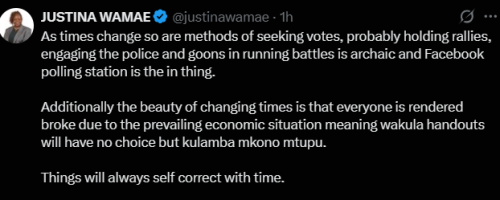
“Things will always self-correct with time,” Wamae added.
Wamae observed that there are broader trends in electoral politics, where social media has become a key tool for mobilising support, especially among young voters who spend significant time online. Campaigns are increasingly using Facebook, WhatsApp, and Twitter to share manifestos, engage in live discussions, and monitor public sentiment, reducing reliance on in-person rallies.
Social media audience
She also notes that economic pressures on citizens can diminish the impact of patronage, forcing political aspirants to find innovative ways to communicate with voters. Digital engagement allows candidates to reach a wide audience at minimal cost while avoiding confrontations that have historically marred elections.
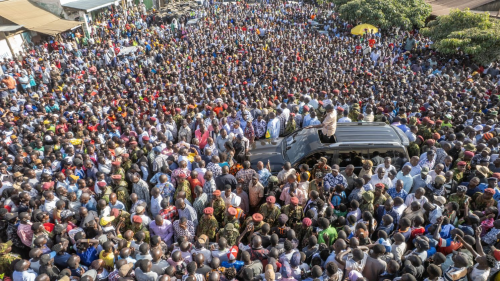
There is an importance for both candidates and the public to adapt to evolving campaign practices; elections are no longer only fought on the streets but also online.
With the next general election approaching, the trend may accelerate, making social media a central arena for voter interaction, debate, and influence, reflecting the changing nature of democracy in the country.