JB Muturi urges urgent action as sugar farmers stare at a crisis
By Kenneth Mwenda, June 13, 2026Former Public Service Cabinet Secretary and Democratic Party (DP) leader Justin Muturi has warned that Kenya’s sugar sector is facing a deep crisis driven by policy failures and rising imports.
He said nearly one million sugarcane farmers in Western Kenya are at risk of economic ruin and accused the government of ignoring their struggles.
“The Government of Kenya cannot continue turning a blind eye while nearly one million sugarcane farmers are pushed to the brink of economic ruin,” Muturi said in a post on X on Saturday, June 13, 2026.
Muturi stressed that the sugar industry is not a minor sector but a key pillar of the national economy. He said the value chain supports more than six million people, including farmers, factory workers, transporters, traders and small businesses.
He added that entire towns in Western Kenya depend on sugar production for survival.
“The sugar sector is not just another industry, it is the lifeblood of Western Kenya and a critical pillar of the national economy,” he said.
Local economies in counties such as Kakamega, Bungoma, Kisumu and Busia rely heavily on sugarcane farming and processing. When factories slow down or delay payments, household incomes fall sharply, and local trade weakens.
Imported sugar and market concerns
Muturi criticised what he called unfair treatment of imported sugar, saying it continues to access the market more easily than local produce.
He argued that local farmers are struggling with delayed payments, high production costs and uncertainty about the future of the sector.
“Any policy, import regime, or regulatory failure that undermines local sugar production is an attack on the livelihoods of millions of Kenyans,” Muturi warned.
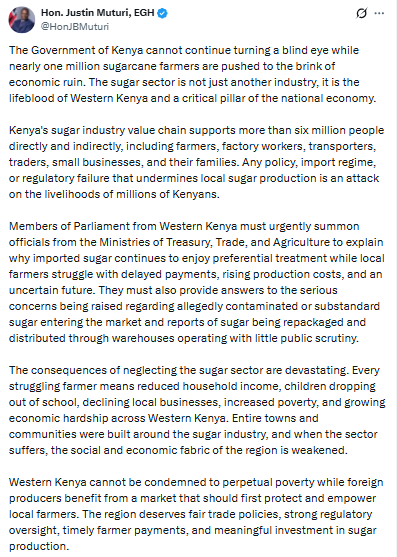
He also raised concern over reports of substandard sugar entering the market and claims of repackaging through warehouses with limited oversight. He called for stronger regulation and transparency in the supply chain.
Muturi urged Members of Parliament from Western Kenya to summon officials from the Treasury, Trade and Agriculture ministries to explain the state of the sector.
He said Parliament must question import decisions and investigate claims around sugar quality and distribution.
He also pointed to concerns raised by farmers over delayed cane payments and rising production costs, which continue to weaken the industry.
Pressure on farmers and rural finance
The crisis in the sugar sector is also affecting borrowing and lending in rural areas. Many farmers depend on SACCOs and bank loans to fund farm operations such as fertiliser and labour.
When sugar mills delay payments, farmers struggle to repay loans on time. This leads to rising interest, penalties and in some cases loss of assets.
Local lenders also become more cautious, tightening credit conditions for small-scale farmers. This reduces investment in farming and slows economic activity across sugar-growing regions.
Muturi said Western Kenya cannot remain trapped in poverty while foreign producers benefit from Kenya’s market. He called for fair trade policies, timely payments to farmers, and stronger regulation of the sugar sector.
“The Government must move with speed to protect sugarcane farmers and safeguard an industry that sustains millions of livelihoods,” he said.