Gachagua cites RSF and Haitian gangs as examples in security warning to Kenyans
By Kenneth Mwenda, April 12, 2026Former Deputy President Rigathi Gachagua has warned that what he called ‘goonism’ could destabilise Kenya, saying organised violence linked to political actors is already emerging in parts of the country.
Speaking during a church service at PEFA Works in Kajiado County on Sunday, April 12, 2026, Gachagua drew comparisons between militia groups in Sudan, Haiti, and local incidents in Kenya, saying the pattern shows how violence grows when it is tolerated or supported.
“Hii maneno ya goonism, it will consume you,” he said. “Hii RSF started as a criminal gang, ya El Bashir. Then it developed into a state militia backed by the state. Today, it is a problem for the people of Sudan.”
He suggested that the Rapid Support Forces (RSF), a powerful paramilitary group involved in Sudan’s ongoing conflict, began as a criminal outfit and later gained state backing before becoming uncontrollable.
“And probably that is why you are happy to work with them,” he added.
Gachagua also made claims about the issuance of Kenyan travel documents, linking them to security concerns.
“Na huyu … wako, ndiye anapeana passports to criminals threatening world order and peace. Criminals of RSF have been given passports here,” he said.
The Interior Ministry has previously denied claims that Kenyan passports are issued to non-citizens linked to the RSF, insisting that strict verification processes are followed before any document is issued.
Gachagua further referenced Haiti’s history of gang violence, saying it showed how armed groups can grow beyond control if not checked early.
“Pale Haiti, the criminal gang was started by Papa Doc Duvalier. He developed it until it got out of hand,” he said. “By the time he left office, it had metamorphosized into something that cannot be contained.”
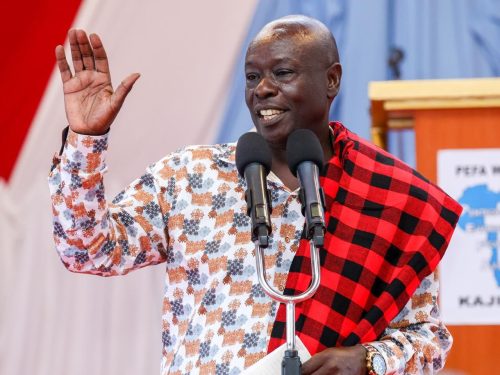
He warned that similar patterns could emerge in Kenya if authorities fail to act.
“These gangs that you are dealing with here, after the meeting, what will they eat?” he asked. “And you have seen already in Nairobi it is happening.”
He claimed that incidents of violence in the capital were linked to organised groups that had been politically activated.
“Since you introduced gangs, every time you come to Nairobi, gangs wanaungana na wewe, wanapora watu,” he said.
“They can go to Nairobi and create chaos,” he added. “We want to advise you to rethink very carefully how you can make Kenya a country of goonism.”
KHRC raises violence alarm
The remarks come at a time when human rights groups have raised concerns about rising political violence.
In a separate statement, the Kenya Human Rights Commission (KHRC) accused what it called “state-backed goons” of organising attacks on political meetings, voter registration activities, and public events in several parts of the country.
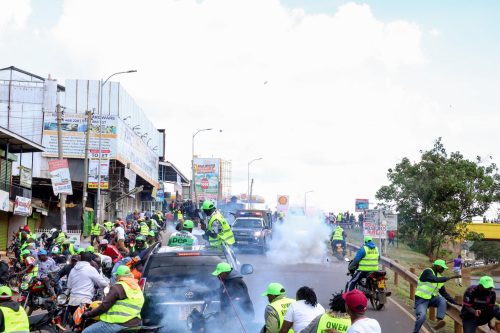
KHRC said incidents had been reported in Kikuyu, Kitale, Roysambu, and Kisumu, where groups of armed youths allegedly disrupted lawful gatherings.
In Kikuyu, the commission said groups of youths blocked roads, attacked motorists, and stole from members of the public during a disrupted political meeting.
KHRC also reported that voter registration in Kitale was briefly stopped after attacks on officials and members of the public.
The commission further cited an incident in Kisumu where Vihiga Senator Geoffrey Osotsi was attacked and injured during a visit to a business complex.
KHRC said police had failed to respond effectively in most cases and only acted after the Kisumu attack, where arrests were later made.
“In all these incidents, police failed to intervene,” KHRC said. “No meaningful action has been taken in the other cases, pointing to the protection of these groups.”
The commission warned that outsourcing violence to militias undermines democracy and constitutional freedoms.
“Outsourcing violence to militias is unlawful and dangerous,” KHRC said. “It undermines constitutional freedoms and is evidence of state complicity. It must stop.”
It also called for accountability at the highest level of the security system, including the resignation of the Inspector General of Police, citing failure to protect citizens.
The National Police Service has not yet responded to the allegations.
Meanwhile, political tensions remain high, with leaders trading blame over the alleged use of organised groups to disrupt political gatherings and civic activities across the country.