David Maraga: Kenya loses an estimated Ksh3 billion daily on corruption
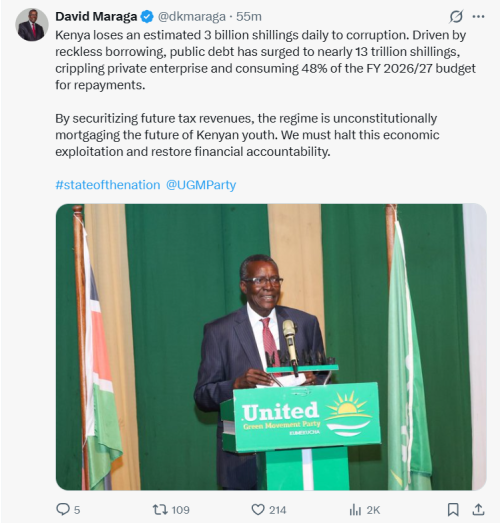
By Faith Lagat, June 16, 2026Former Chief Justice David Maraga, now United Green Movement (UGM) presidential flagbearer, has sharply criticised the government’s fiscal management, warning that Kenya is losing an estimated Ksh3 billion daily to corruption while reckless borrowing has pushed public debt to nearly Ksh13 trillion.
Maraga said this on Tuesday, June 16, 2026, during the “State of the Nation: The Way Forward Dialogue” held at Ufungamano House in Nairobi.
According to Maraga, the debt burden is “crippling private enterprise” and consuming 48 per cent of the FY 2026/27 budget for repayments, and pilferage of public resources through corruption is worsening the situation.
He accused the regime of unconstitutionally mortgaging the future of Kenyan youth through securitisation of tax revenues.
“By securitising future tax revenues, the regime is unconstitutionally mortgaging the future of Kenyan youth. We must halt this economic exploitation and restore financial accountability,” Maraga declared.
Debt levels
His remarks come days after Treasury Cabinet Secretary John Mbadi presented the Ksh4.78 trillion budget to Parliament on June 11, 2026, and proposed tools such as debt-for-food and debt-for-development swaps to ease fiscal pressure. Public debt stood at Ksh12.82 trillion by March 2026, rising toward KSh13 trillion, with domestic debt at Ksh7.14 trillion and external debt at Ksh5.68 trillion.
Government data shows debt stood at Ksh11.81 trillion (67.8% of GDP) as of June 2025. By February 2026, it had climbed to Ksh12.84 trillion (69.5% of GDP). In 2024/25, the government paid Ksh1.72 trillion in debt servicing.
For 2026/27, debt repayments are projected at nearly half the budget, about Ksh2.31 trillion, including Ksh1.25 trillion in interest.
Calls for audit and fiscal reforms
Lawyer Willis Otieno echoed Maraga’s concerns in a statement on June 12, 2026, calling for a shift “from emotional rhetoric to structural honesty.” He demanded a full forensic audit of public debt “loan by loan, project by project” and a transparent record of how borrowed funds were utilised.
“Publish a verifiable account of every shilling borrowed and how it translated or failed to translate into productive assets,” Otieno said. He also urged elimination of duplicated agencies, inflated administrative costs, and austerity starting from the Executive.
Kesses MP Julius Rutto added that debt obligations leave little room to avoid new taxes, as a large portion of resources goes to servicing and domestic borrowing, squeezing private sector liquidity.
Mbadi has defended the government’s strategy, highlighting refinancing of high-cost loans, extended maturities, concessional financing, and new instruments, including Samurai Bonds, Panda Bonds, and Sukuk.
He maintains debt remains sustainable but acknowledges heightened distress risks, with monthly briefings promised for greater transparency.